A training certificate is the document that proves someone has completed a training programme, passed an exam, or reached a certain level of competency. It might be a diploma from a vocational higher education provider, a certificate from an internal safety training, a credential from a professional association, or proof of completion from a course provider.
Most training certificates look roughly the same: a piece of paper with a name, a date, and a logo. Or a PDF sent by email. The format has not changed meaningfully in decades -- despite everything else about how we work, recruit, and verify competence having gone digital.
The problem? Paper and PDF files can be forged. And no one can verify them without calling the training provider and asking: "Did you issue this?"
There is a better way.
Paper certificates
Paper documents have served their purpose for hundreds of years. But as training certificates, they have obvious limitations:
Easy to forge. A scanner and a printer is all it takes. The print quality of modern copying machines makes it nearly impossible to distinguish an original from a copy.
Can be lost. Moving house, water damage, fire -- and the certificate is gone forever.
Impossible to share digitally. You can scan and email, but any security features disappear in the process.
Verification takes days. The employer calls the training provider. If it still exists. If the right person answers. If they can locate the right record in the archive.
PDF certificates
The PDF format solved one problem -- sending documents between systems without losing formatting. But it was never designed for security.
Can be edited with free software. Text, dates, names, logos -- everything can be changed in a few minutes.
No built-in verification. Anyone can create a PDF that looks official.
No traceability. There is no way to tell whether a PDF has been changed since it was created.
Files disappear. Deleted emails, crashed hard drives, lost downloads.
In an era where skills supply, recruitment, and compliance are becoming increasingly important, the formats we have used since the 1990s are no longer fit for purpose.
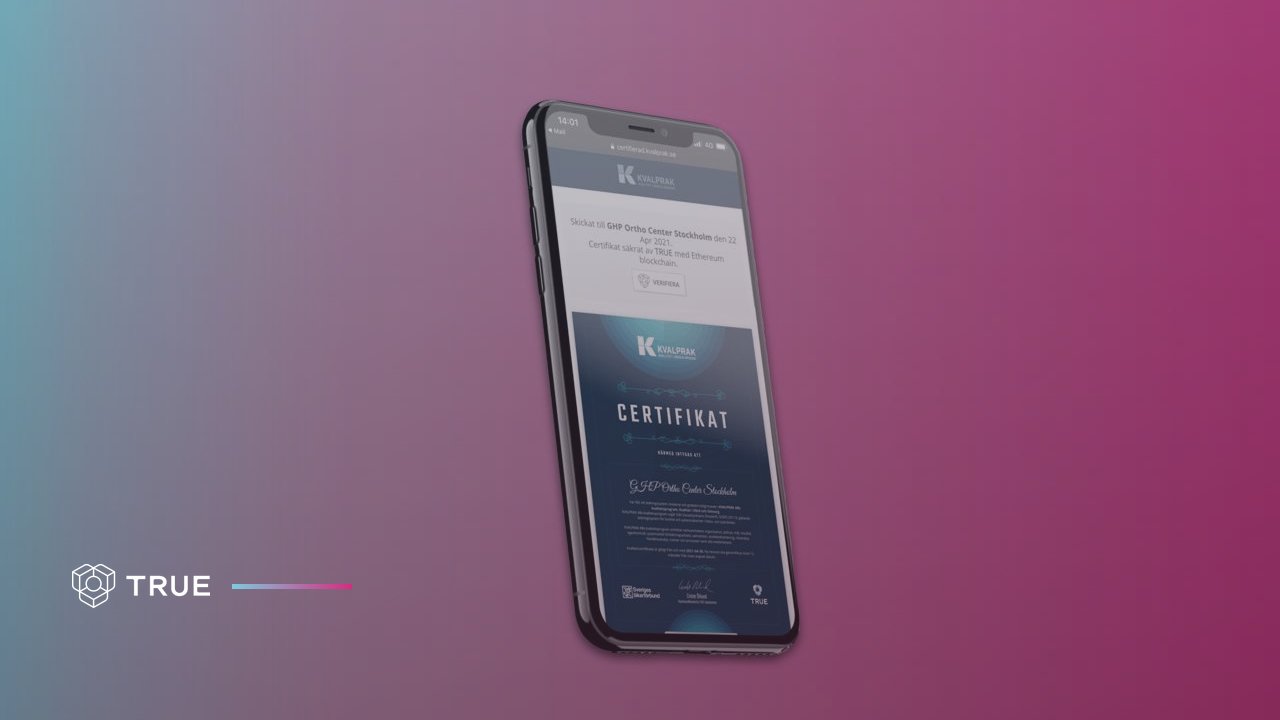
A digital training certificate issued through TRUE Original is not a file -- it is a verifiable web page. Each document receives a unique cryptographic fingerprint (SHA-256 hash) that is registered on a blockchain.
cannot be forged undetected
Change a single character in the document -- a date, a name, a letter -- and the fingerprint changes. Verification fails immediately. It is binary: genuine or tampered.
Verification in seconds
No one needs to call and ask. Scan the QR code with a phone or click the verification link. The answer comes instantly.
Permanently accessible
The training certificate never disappears. No crashed server, no lost email, no archive that gets discarded. The document is accessible via its unique link -- forever.
Independent of TRUE
Verification data is stored on blockchains (Ethereum, Polygon, AVAX, Fantom). Even if TRUE ceased to exist tomorrow, every issued training certificate would still be verifiable. The proof outlives the platform.
eIDAS-compatible
TRUE meets EU requirements under the eIDAS regulation for electronic identification and trusted services. Training certificates issued through TRUE have a legal basis under European law.
This is where it gets interesting for organisations that issue training certificates. A TRUE document is not just a proof -- it is a marketing channel.
The LinkedIn loop
This is not theory. TRUE has generated 100 million+ marketing impressions and EUR 9.5 million+ in estimated marketing value for issuers.
"Our alumni now have nice looking Diplomas in an accessible format, but we also see great marketing value!"
-- Sissel Gade, AW Academy
"A clear advantage of our new digital certificates is how easily they can be added as a reference to LinkedIn or a digital CV."
-- Lina Fjäll, Astrakan
Every shared training certificate is free marketing for your organisation. You do not need to ask for it. It happens naturally.
Getting started with issuing digital training certificates through TRUE requires neither blockchain expertise nor a technical background.
Step 1: Design your template
Create training certificates that reflect your organisation's visual identity. Your logo, your colours, dynamic fields for the recipient's name, course name, and date. TRUE certificates can be animated and interactive.
Step 2: Issue
After training is completed, issue certificates via TRUE's dashboard, by email, or via REST API connected to your LMS. TRUE integrates with Canvas, Moodle, Learnster, and Salesforce.
Step 3: The recipient receives and shares
The recipient gets their training certificate by email with a unique link. They can share it directly to LinkedIn with one click, embed it on their website, or present the QR code when needed.
Step 4: Verification -- by anyone
An employer, a client, an auditor, or a regulator scans the QR code or clicks the link. Verification happens immediately. No account needed, no app to download.
Your domain, your brand
Training certificates live on your organisation's website -- not TRUE's. Every share drives traffic and SEO value to your site.
TRUE is a Swedish company headquartered in Stockholm. The platform is used by 200+ organisations in 15+ countries, with 900,000+ documents issued.
"This is absolutely brilliant! A thousand thank you's!!"
-- Tania Sjöberg, Skanska (L&D)
"Our alumni now have nice looking Diplomas in an accessible format, but we also see great marketing value!"
-- Sissel Gade, AW Academy
Nackademin, TUC, FEI, Dale Carnegie Sweden, SSF, and Trädgårdsakademin are among the organisations that have chosen TRUE for their training certificates.
If you are still issuing training certificates as paper or PDF, ask yourself three questions:
Can an employer verify your certificates in under 10 seconds?
Are your recipients sharing their certificates on LinkedIn?
Would your certificates survive a forgery attempt?
Blockchain-verified training certificates answer yes to all three. And it takes weeks -- not months -- to get started.
Your training programmes build competence. Your training certificates should build trust -- and your brand.
Book a FREE demo at trueoriginal.com/contact
What is the difference between a training certificate and a certification?
In everyday usage the terms are often used interchangeably. Technically, a training certificate is a document confirming completed training, while a certification often implies passing an exam. TRUE supports both -- as well as diplomas, attestations, licences, membership credentials, and more.
How do I know that a digital training certificate is genuine?
Scan the QR code or click the verification link. The system compares the current content of the document against what was registered on the blockchain. If they match, the certificate is genuine.
Does it work with our LMS?
TRUE integrates with Canvas, Moodle, Learnster, and Salesforce. There is also a REST API with 5 endpoints for custom integrations.
What does it cost?
TRUE is priced per issued document. Contact TRUE for a quote based on your organisation's volume and needs.
Can recipients share the certificate on LinkedIn?
Yes -- TRUE certificates can be shared directly to LinkedIn with one click, added to the profile under "Licences and certifications", or embedded on a website.
Is TRUE a Swedish company?
Yes. TRUE Original (TRUE Value Software AB) was founded in 2020 in Stockholm by Patrik Slettman and Victor Wallander. The company is eIDAS-compatible and is working towards ISO 27001 certification.
Every organisation we work with started with the same question. Give us thirty minutes and we will show you what your own documents would be worth.
Book a callNot sure where to start? Let us help!

Trusted by leading organisations worldwide