


Features
Features of the TRUE digital certificate platform
TRUE issues credentials anyone can verify: in your design, on your own domain, at any volume, with the proof anchored on a public blockchain. This page is what the platform does, grouped by the job you are trying to get done.
The shape is the same whatever you issue. You issue, TRUE seals the document and anchors its fingerprint, the recipient gets a page they own and can share, and anyone can check it in seconds without an account. Everything below serves one of those four steps.
What can you do with TRUE?
Six products run on the same trust engine. Most organisations start with TRUE Original, which is the issuing platform, and reach for the others when the question turns from issuing to signing, storing or being found.
 TRUE Verify
Check whether a document you received is genuine
Wallet
TRUE Wallet
Collect your own credentials in one place you can share
TRUE Verify
Check whether a document you received is genuine
Wallet
TRUE Wallet
Collect your own credentials in one place you can share
 TRUE Sign
Get a contract signed and sealed
TRUE Sign
Get a contract signed and sealed
 True Upskill
TRUE Upskill
Get your courses in front of people who want to learn
True Upskill
TRUE Upskill
Get your courses in front of people who want to learn
How do I issue credentials at scale?
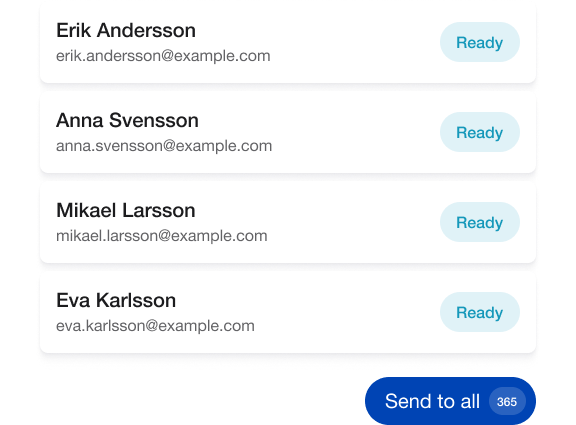
Issuing runs from a file or from your own system. Upload a spreadsheet and every row becomes a finished credential, or call the API and let the system that already knows who passed do the issuing. A full year of diplomas goes out in one operation, and nothing has to pass through a person.
- Bulk upload. Issue a whole course, class or year from one CSV or XLS file.
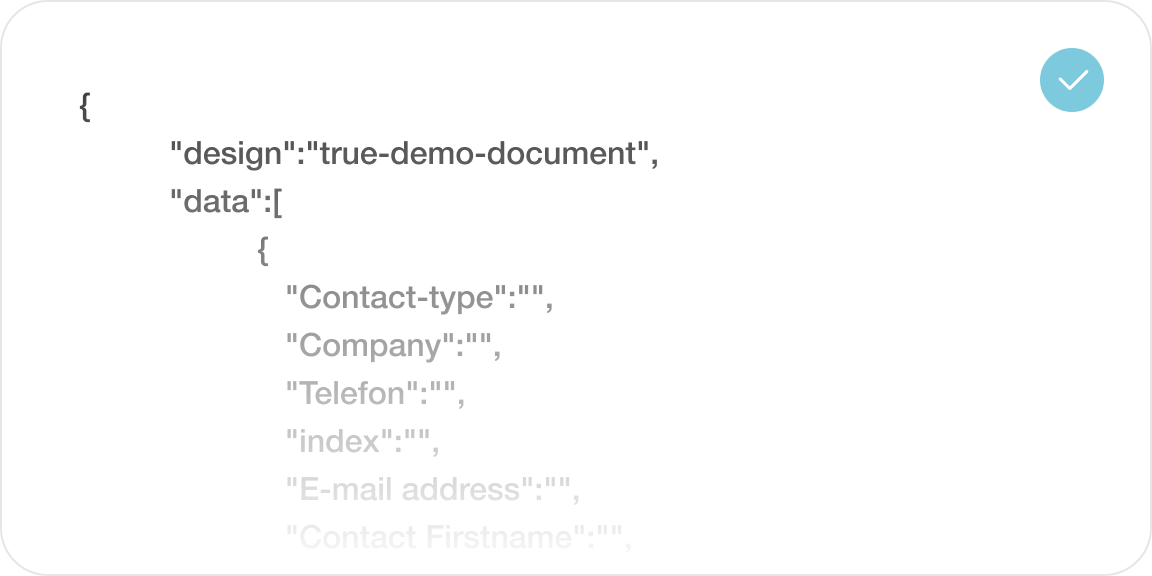
- API issuing. Five endpoints, webhooks, and an email API that issues a document from a message you send us. See the TRUE API.
- Scheduled issuing. Set the date and the documents go out on their own.
- Automatic expiry. Credentials that need renewing carry their own end date.
- Dynamic tags. Name, grade, date and any other field fill themselves per recipient.
- Multi page documents. A diploma and its appendix stay one document.
- Inactive state. Hold a document back or take it out of circulation without deleting it.
- Bulk export and auto export. Take everything back out again, by file transfer or by API.
- MYH robot. Swedish vocational providers get the repetitive administration around their programmes handled automatically.
Can the documents carry our design and our own domain?
Yes, and that is the part worth doing properly. The document, the page it lives on, the emails around it and the address in the browser can all be yours, so a recipient never leaves your brand to prove something you gave them.
- Design templates. Start from a TRUE template and adapt it, or bring your own design.
- Animated documents. Movement in the document itself, which is what people screenshot and share.
- Your own domain. Credentials live at your address, not at a supplier address.
- Issuer page and about page. A public page that presents your organisation and what you issue.
- Public document index. Every issued document searchable on your own issuer page, so a visitor can check one without asking you.
- Branded emails. Styling, footer and links on every message that leaves the platform.
- Web templates and custom meta descriptions. The public pages carry your wording, including what search engines show.
How does anyone prove a document is genuine?
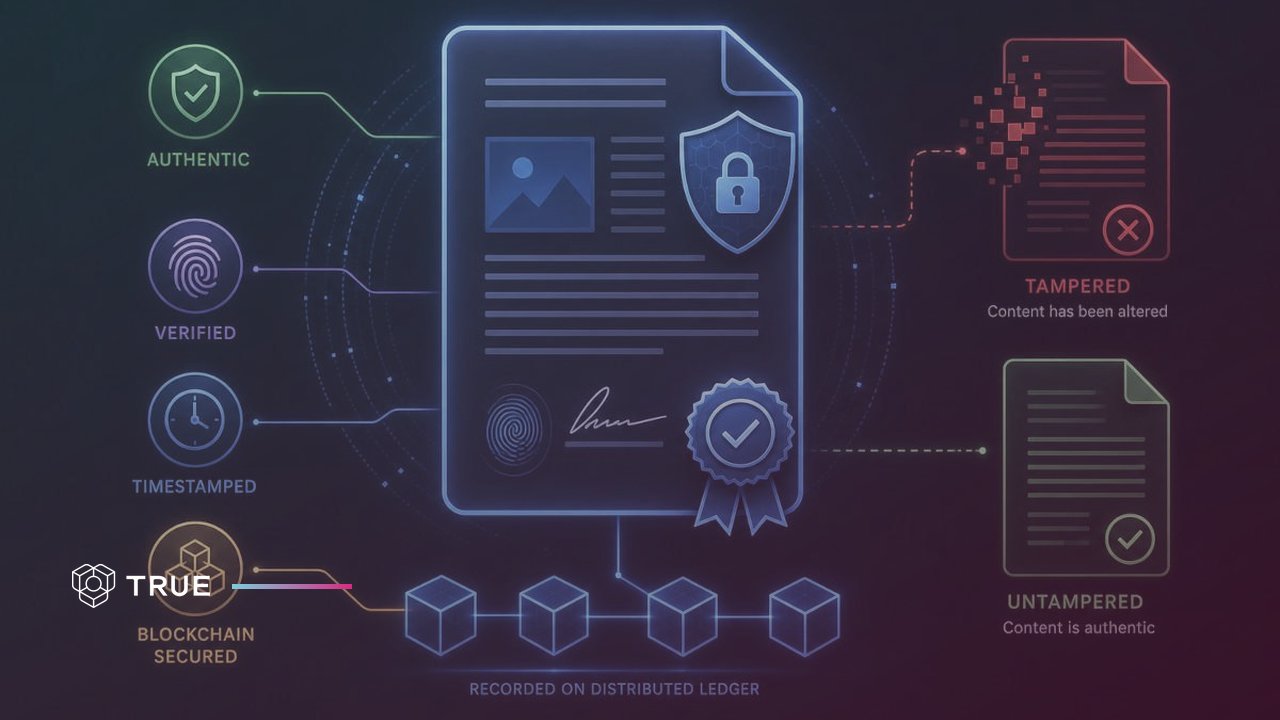
Every TRUE document carries its own proof. The file is sealed and its fingerprint is anchored on a public blockchain, so checking it does not depend on us being online and does not mean calling your office. Verification is free and open to anyone.
- Blockchain anchoring. The fingerprint of the document goes on a public chain, where it stays readable independently of us.
- TRUE Verify. Anyone can drop in a file or a link and see in seconds whether it is genuine and untouched. Free, no account. Try it.
- QR code and verification link. Printed or forwarded, the document takes the check with it.
- Certificate of authenticity. For objects and products, where the proof has to survive a change of owner.
- Document register. One place that tracks every credential you have issued.
- Competence register. A searchable register of who is qualified, when they were approved and when retraining is due.
The reason this matters is the checking, not the issuing. Independent research keeps finding the same gap between how often credentials are faked and how often anyone verifies them:
- 18% of UK adults say they have lied on a CV or job application, or know someone who has, within the last 12 months. Published by Cifas, the UK fraud prevention service, February 2025, from a survey of 2,000 UK adults.
- 45% of large employers have uncovered a false qualification claim, and only 52% verify all academic credentials. Verification falls to 37% at medium sized organisations and 29% at small ones. Source: Prospects Luminate, November 2025, from a survey of 526 HR decision makers.
More on the detection side in our guide to fake certificate verification.

What does the recipient actually get?
A page they own, not an attachment they lose. The credential lives at its own address, goes to LinkedIn in one click, and sits in TRUE Wallet next to everything else that person has earned. That is also where your reach comes from: every share puts your name in front of a network you do not have to buy.
- TRUE Wallet. One page that collects a person’s verified diplomas, certificates and skills, ready to show an employer. See TRUE Wallet.
- Apple and Google wallet. The credential travels in the phone people already carry.
- Badges and personalised badges. Shareable marks for achievements and milestones.
- Micro credentials and pathways. Short credentials that stack into a longer route, so finishing one leads somewhere.
- Metadata. Skills, earning criteria and custom attributes travel with the credential, which is what makes it readable to a recruiter and to a machine.
- Custom LinkedIn share text. You decide the wording that goes out with the post.
- Transfer and request. Ownership can move to a new holder, and a recipient can ask you for a document they are missing.
“It is great to see how many of our students share their credentials on LinkedIn. We take that as a sign that they are proud of the training they have completed.”
Does TRUE work with the systems we already use?
Usually yes, and without a project. Over twenty platforms have a documented route into TRUE, from learning platforms to CRM systems, and anything else connects through the REST API, through Zapier or by email.
All of them, with what each one does, are on TRUE integrations. Single sign on is available for the people who administer your account, so joining and leaving follows your own directory.
Can we sign agreements and protect other files too?
Yes, and it is the same proof underneath. TRUE Sign sends a PDF for signature and returns a sealed file with a Proof of Signing. TRUE Vault does it for files nobody signs: upload one and its fingerprint is anchored, so years later you can still prove it has not changed.
- TRUE Sign. Everyone signs on any device, with no app and no account for the people signing. See TRUE Sign.
- Signers on a credential. Add the people whose names belong on the document, with an advanced flow when several have to sign in order.
- TRUE Vault. Agreements, protocols, valuations, board minutes, anything worth being able to prove later. See TRUE Vault.
- Product passport. A product carries its own documented history, which is what a buyer and a regulator both ask for.
- Restricted documents. Some proof should not be public. Access can be limited to the people who need it.
Who signs, and how do we know it was them?
Signing runs in TRUE Sign, and the person signing needs no app and no account. When the agreement needs a higher bar, the signer identifies themselves with an eID, and the verified name is written into the signature log where it stays with the document.
- Freja eID. Live today, with full support for every citizen of the EU and the EEA, and registration through a biometric NFC passport in more than 170 countries. No extra cost, on every plan.
- Swedish BankID. For Swedish counterparties, the eID they already carry on their phone.
- Email verification. The level most agreements run on, with the same evidence package around it.
- Proof of Signing. The sealed PDF carries who signed, how their identity was checked, the full event log and a fingerprint anchored on a blockchain.
- Event log. Created, sent, viewed, signed, sealed, each step timestamped on the document itself.
- Signing order. Everyone at once, or one after another, where the next signer is only invited when the previous one is done.
Electronic signatures are legally valid under the EU eIDAS regulation and Swedish law. What each level means, and when a stricter one is actually required, is in our guide to electronic signatures.
How secure is TRUE itself?
The product is proof, so our own house gets audited from the outside rather than described from the inside.
- Certified under SSF 1101, Cybersecurity Basic. A Swedish standard from the Swedish Theft Prevention Association, certified by SBSC, covering information security, access control, incident management, staff awareness and protection against external threats.
- Cyber Hygiene certification from OneMore Secure, an external review of how we run day to day.
- Data stays in Europe. Personal data is processed within the EU and EEA.
- Encrypted in transit and at rest. Documents travel over TLS and are stored encrypted.
- Only a fingerprint goes on the chain. No document content and no personal data is ever written to a blockchain, so the proof is public while the document stays private.
- No third party cookies, and nothing sold on. We do not sell personal data, and the site sets no third party cookies.
- Uptime commitment. Enterprise agreements carry a 99.9 percent uptime commitment for the API.
How personal data is handled, and what rights a recipient has, is set out on our GDPR page.
What do we learn once the credentials are out there?
Each credential reports back. You see how many were issued, opened, verified and shared, which is the part a paper certificate never told you, and you can act on it from inside the platform.
- Statistics and insights. Issuing, verification, sharing and engagement per document, course and period.
- Real time notifications. Activity, requests and approvals as they happen.
- Email notifications and reminders. Issuing, updates and follow ups, sent for you.
- Email campaigns. Use the engagement data to invite people back, renew a credential or fill the next course.
- Recommendations. Your credentials get shown to people who are actively looking to learn.
- TRUE Upskill listing. Course providers who issue verified credentials through TRUE can have their courses listed in the Upskill catalogue. Free, optional, and enquiries go straight to you. See TRUE Upskill.
- Reviews and affiliate programme. Collect feedback on what you issue, and let partners pass it on.
What is a digital credential worth to us?
Every document you issue reports back with a number attached. TRUE values four things: the exposure a shared credential creates, the time it saves, the errors and fraud it prevents, and the verification work it removes. The model is published in full, every part of it is deliberately set low, and each customer sees the result on their own dashboard.
Brand exposure
Shares and opens are counted as clicks and impressions, then valued with the same CPC and CPM benchmarks advertisers pay, weighted by source. For one education customer, a single month of shared documents came to roughly 900 EUR of advertising nobody bought.
Time saved
Ten minutes per document against manual handling, seven in creating it and three in everything that follows it, at an hourly rate you set yourself.
Risk protection
Around 15 percent of documents prevent a fraud or a material error, a figure that sits inside the 10 to 20 percent range international studies report.
Verification cost
A manual check costs about fifteen minutes of someone’s time. Automated checking removes that, and it means the check actually happens.
The whole model, with the source behind every assumption, is in how we calculate the value of digital documents.
Who can see what, and who can do what?
Access is set per person and per document. Teams get roles, sensitive documents can be restricted, and an organisation with several brands or subsidiaries can run them side by side under one account.
- Team roles and advanced permissions. Control who issues, who approves and who only looks.
- Single sign on. Administrators use the login they already have.
- Sub and sister accounts. Several brands, schools or subsidiaries, governed in one place.
- Languages. Issue in the language the recipient reads.
- Storage. Documents stay available, with room to keep issuing.
How the data is handled is set out on our GDPR page.
What happens when we start, and what does it cost?
Every account starts with onboarding, and support sits with people who work on the platform rather than a ticket queue. Response times follow the agreement.
Pricing is set per organisation, because what an issuer needs varies by volume, design and how much of the platform they use. More than one product can be negotiated into a single agreement, so bring the whole picture to the call rather than one product at a time.
Frequently asked questions
Do recipients need an account to see their credential?
No. The credential lives at its own web address and opens in any browser. An account only matters if the recipient wants to collect everything in TRUE Wallet.
Can anyone verify a TRUE document?
Yes. Verification is free and open to anyone through TRUE Verify, with no account. Drop in the file or the link and see in seconds whether it is genuine and untouched.
Can we keep our own design and our own domain?
Yes. Documents follow your design, the public pages and emails carry your brand, and credentials can be served from your own domain so recipients stay with your name.
Does TRUE work with our LMS?
Over twenty platforms have a documented route into TRUE, including Moodle, Canvas, Learnifier, TalentLMS, Totara and Thinkific. Anything else connects through the REST API, through Zapier or by email.
What happens to our credentials if TRUE disappears?
The fingerprint of each document is anchored on a public blockchain, so it can be checked independently of us. That is the point of anchoring rather than storing proof in one company.
Can we issue in more than one language?
Yes. Documents can be issued in several languages, so a recipient reads the credential in the language they use.
What does TRUE cost?
Pricing is set per organisation and depends on how much you issue and what you need around it. Book a demo and you get a figure for your own case, including what can be negotiated into one agreement.
Which electronic ID can signers use?
Freja eID is live today and works for every citizen of the EU and EEA, plus more than 170 countries through registration with a biometric NFC passport. Swedish counterparties can use BankID. Signers without an eID verify by email, and every signature carries the same Proof of Signing.
Where is our data stored?
Personal data is processed within the EU and EEA. Documents travel over TLS and are stored encrypted, and only the fingerprint of a document is written to a blockchain, never its content.
What would this be worth for you?
The calculator runs the same four parts on your own numbers: how much you issue, how often a document gets checked, what an hour of your people’s time costs.