



Canvas Integration
Issue TRUE certificates from inside your Canvas course
TRUE Original is a Canvas app that is in production today. It installs once in Canvas and is then switched on as a tab in the courses you choose. Inside a course it already knows which course it is and who is on it, and course staff issue a branded, blockchain secured certificate to a participant from that tab. Nothing is exported, and nobody retypes a name.
TL;DR
TRUE Original is a Canvas app built on LTI 1.3, the standard Canvas uses for external tools. A Canvas administrator adds it once with a developer key, then switches the tab on for the courses that should have it. Inside a course the app reads that course's own participant list through the Canvas roster service, so issuing a certificate is choosing the person and pressing send. The certificate carries your design, sits on your own domain, and is written to blockchain at the moment it is issued.
- An app, not a project. TRUE Original is already built and in operation, and it installs through the same developer key screen your Canvas administrator already uses.
- Installed once, per institution. One developer key and client id covers every course, and each course decides whether to show the tab.
- Inside the course. The app sees the course and its participants, so nothing has to be exported to a spreadsheet first.
How does the Canvas certificate integration work?
Canvas already holds the two things a certificate needs: which course this is, and who is on it. TRUE Original is a Canvas app that reads both through LTI 1.3, the standard Canvas uses for external tools, and issues from there. There is no export, no upload and no second list to keep up to date.
1
Your administrator installs the app
A Canvas administrator adds TRUE Original with a developer key and client id, the same way any external tool is added. It is done once for the institution and we do it together with them.
2
Switch the tab on where you want it
The app appears in the course navigation as TRUE Original. It stays off until a course turns it on, so a pilot on one course is a single setting rather than a rollout.
3
Issue from inside the course
Open the tab, pick the participant, and the certificate is issued and delivered to them. The course title and the participant's own details come from Canvas, so they match the course record exactly.
Inside Canvas
What the tab actually looks like
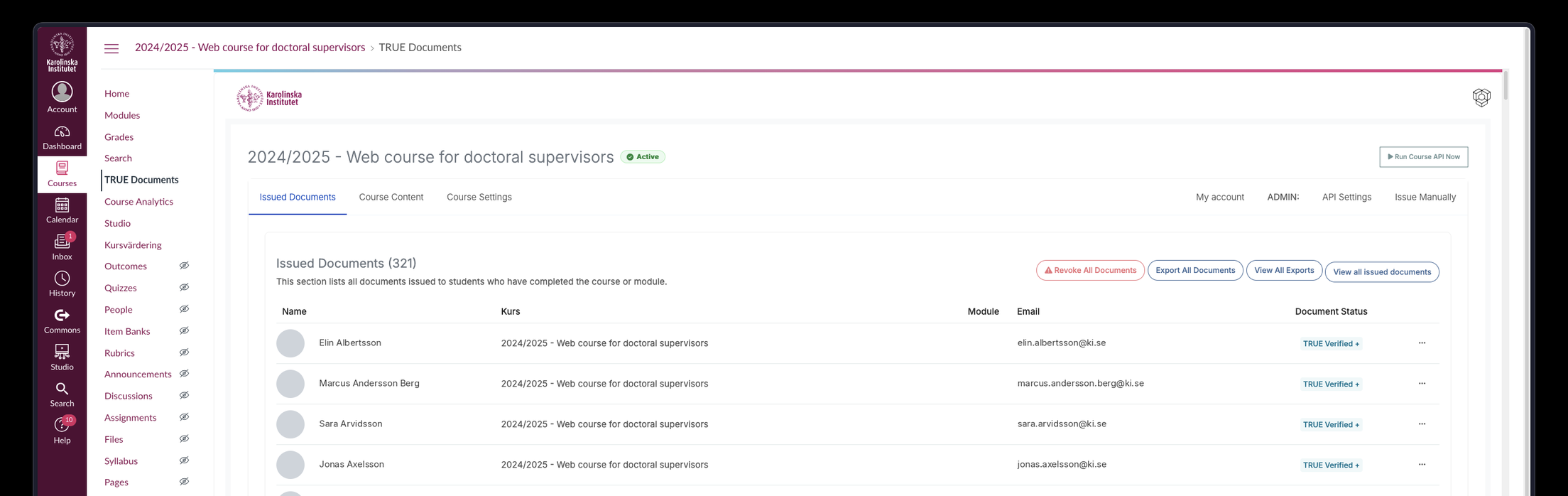
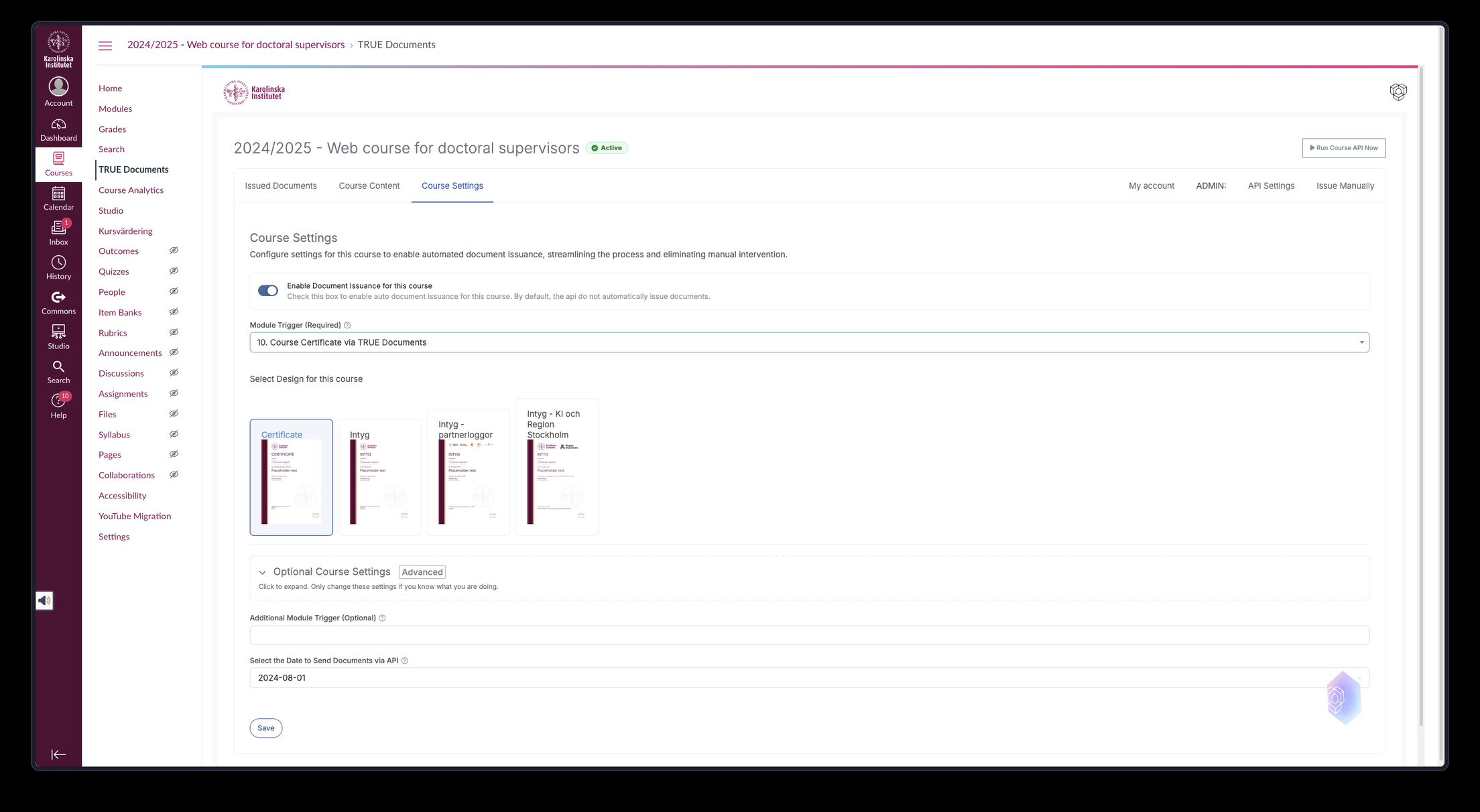
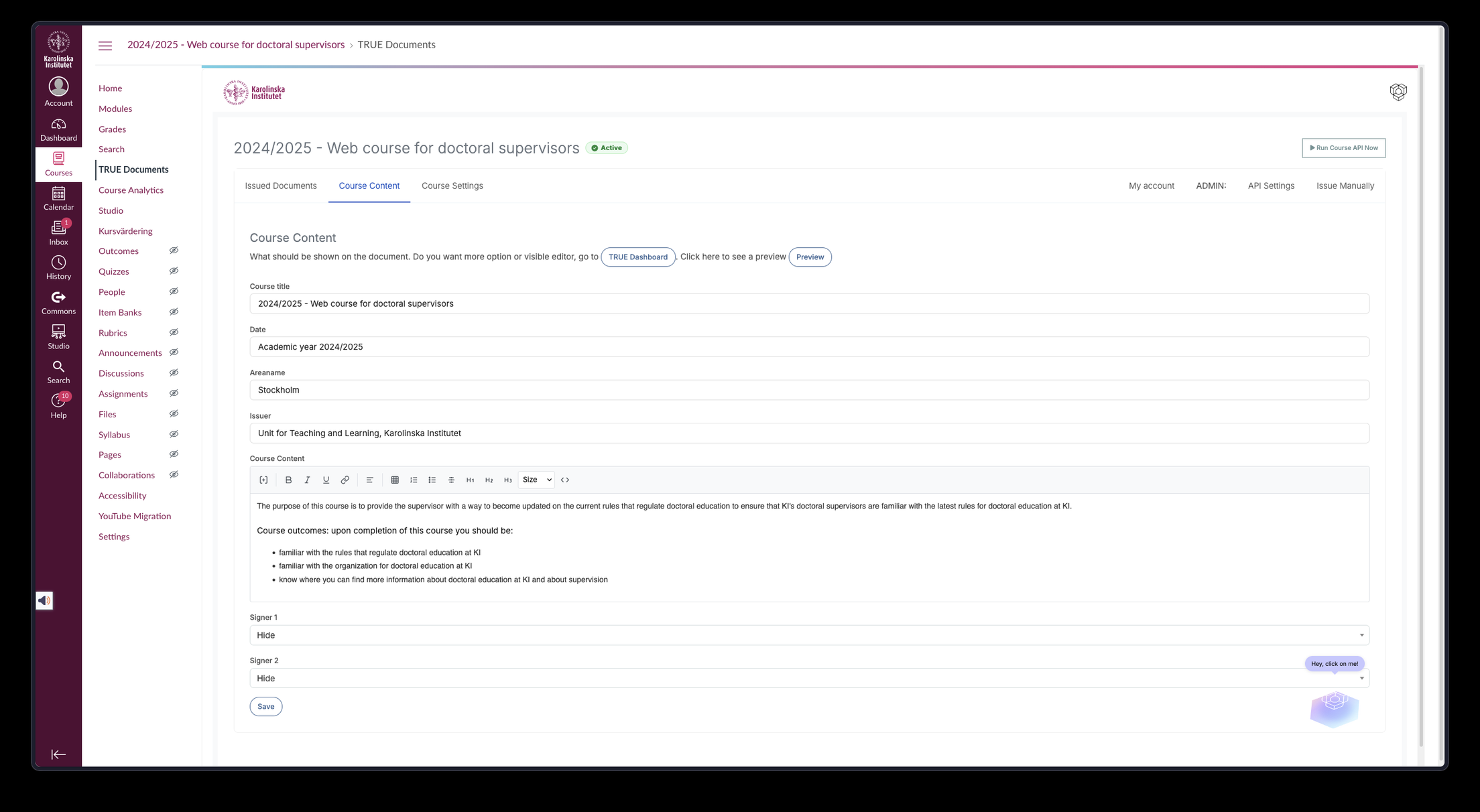
Real screens from a live TRUE Original tab, Karolinska Institutet's own doctoral supervisor course. Names and emails in the document list are placeholder demo data, not real recipients.
Issued documents, per course
Every certificate the course has issued, who it went to and its verification status, without leaving Canvas.
Which course triggers a certificate
Course staff turn issuance on, pick the module that marks completion, and choose the certificate design. No code, one screen.
What goes on the certificate
Course title, dates, issuer and the course description carry straight onto the document, edited from the same tab.
What does the certificate carry?
You decide what the certificate carries. Most issuers start with the participant name, the course, your institution and the date it was issued, written to blockchain at the moment of issue so it cannot be edited or backdated afterwards.
- Your document, your fields. Add what matters to you and leave out what does not. A certificate can run to several pages when there is more worth recording.
- Participant name and course. Read from the Canvas course itself, so it matches your course record rather than a copy of it.
- Your organisation. The certificate is branded as yours and lives on your own domain.
- Date of issue, fixed. Written to blockchain at issuance, which is what makes backdating impossible.
- A permanent verification link. An employer confirms it by opening the link or scanning the QR code, without contacting you.
What has to be in place before it can be switched on?
A Canvas administrator and a certificate design. The administrator part is one screen in Canvas. The design is either one we build to your graphic profile or one you adapt yourself from a template, and it is the only part that needs decisions from you.
- A Canvas administrator who can create a developer key. Course staff cannot install an external tool themselves, which is the same rule Canvas applies to every app.
- The courses you want covered. The tab is off by default, so you choose where it appears rather than having it turn up everywhere at once.
- A certificate design, built by us to your profile or adapted by you from an existing template.
What does a participant receive?
A branded, animated certificate delivered by email, on your own domain rather than ours. It carries a QR code and a permanent verification URL, so anyone can confirm it without contacting you, and it goes onto a LinkedIn profile in one click.
- Animated and branded. An interactive page in your design rather than a static PDF.
- A shareable link. One URL that works in an email signature, a portfolio or a CV.
- QR code verification. An employer, a client or a regulator confirms the credential instantly. Anyone can run the same check at TRUE Verify.
- LinkedIn ready. Added to a LinkedIn profile in one click.
- Blockchain secured. It cannot be edited, forged or backdated after issue.
How is participant data handled?
The app reads the course it was opened in and the people enrolled on it, through the roster service that is part of the LTI 1.3 standard. That means the participant's name and email address and their role on the course, which is what a certificate needs to exist. It does not read your wider Canvas account.
TRUE is hosted in the EU. Because installation goes through a developer key your own administrator creates, you control the scope from your side and can withdraw it in the same place.
How much has TRUE issued for organisations like yours?
More than 900,000 documents for over 200 organisations in 15 or more countries, and credentials shared by their recipients have produced over 100 million marketing impressions.
500K+ Documents issued
200+ Organisations
15+ Countries
100M+ Marketing impressions
Is a completed Canvas course on its own enough?
It proves the course was completed inside your institution's system, which is enough internally. What it cannot do is prove anything to somebody outside it, and that is the part the app and TRUE add.
| Capability | Canvas on its own | Canvas with TRUE Original |
|---|---|---|
| Proof outside your institution | The reader has to take it on trust | A permanent verification link anyone can open |
| Tamper proof | No | Yes, written to blockchain at issue |
| Lives on your domain | No | Yes, branded on your own domain |
| LinkedIn shareable | A file to attach | One click add to LinkedIn |
| Where staff work | Export a list, then use another tool | A tab inside the course itself |
| Analytics | None | Views, shares and verifications tracked |
What do Canvas administrators ask about this?
Three questions, nearly always the same three. A Canvas administrator installs the app once, for the whole institution. After that it sits quiet: no course gets the tab until that course switches it on, and the app reads only the course it was opened in, never the rest of your Canvas account.
Does the Canvas integration have to be built?
No. TRUE Original is an existing Canvas app, in production today. It is installed the same way as any other external tool in Canvas, with a developer key and a client id.
Who installs it?
A Canvas administrator, because Canvas only lets an administrator create a developer key. We do the installation together with them, and it is done once for the institution rather than once per course.
Will it appear in every course?
No. The tab is off by default and each course turns it on, so you can start with one course and widen it when you are ready.
What can the app read?
The course it was opened in and the people enrolled on it, through the roster service in the LTI 1.3 standard. That is the participant name, email address and role. It does not read the rest of your Canvas account.
Do participants need a TRUE account?
No. The certificate arrives by email with a unique link. No login, no account and no app.
Can the certificate carry our own design?
Yes. We build the design to your graphic profile, or you adapt one from an existing template. The certificate is branded as yours and lives on your own domain.
Can we issue certificates for courses that already finished?
Yes. Earlier completions can be issued as a batch, so a backlog does not have to be handled by hand.
What does a recipient do with the certificate?
Share it. It is a link rather than a file, so it goes on a LinkedIn profile in one click and into an email signature or CV, and every share points back to a verification page carrying your name.
Ready to switch it on?
We prepare your certificate design, your Canvas administrator adds the developer key, and the first course can start issuing the same day.