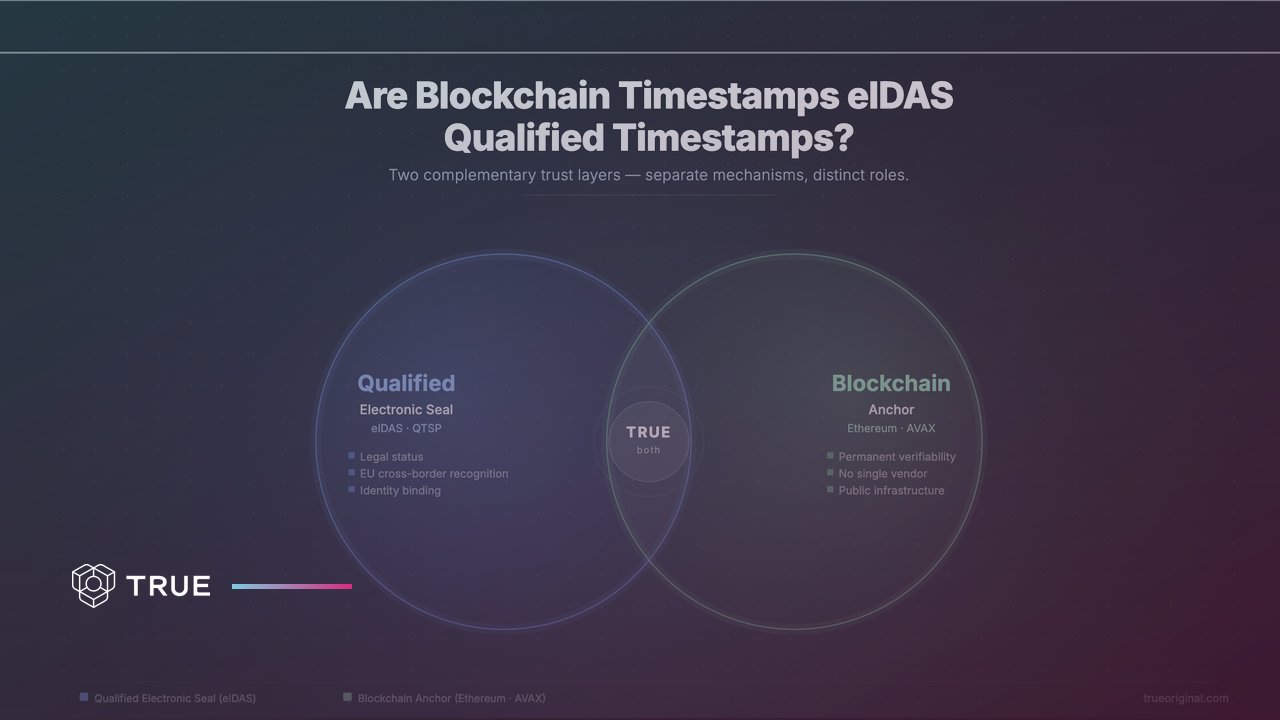
TL;DR: No — a blockchain timestamp is not automatically an eIDAS qualified electronic timestamp. "Qualified" under eIDAS requires the timestamp to be issued by a Qualified Trust Service Provider (QTSP) on the EU Trusted List. A blockchain anchor proves something different: a file existed in a specific form at a specific moment, independently verifiable by anyone, with no single vendor in the trust path. The two are separate mechanisms with complementary roles. TRUE pairs both — a QTSP-issued eIDAS qualified electronic seal (certificate from SK ID Solutions AS, on the EU Trusted List, 2026-05-05) for EU-wide legal status, and a blockchain anchor on Ethereum, AVAX, Fantom, and Polygon for independent verifiability. The blockchain layer does not make the seal "qualified." That status comes from eIDAS and a QTSP, full stop.
You're evaluating a timestamp or credential platform. The vendor says "blockchain-secured." Your compliance brief asks for eIDAS qualified electronic timestamps. Does the first satisfy the second?
The wrong assumption shows up later — in a dispute, in an audit, in a cross-border admissibility review. This article gives the precise answer, defines the eIDAS terms, and explains how blockchain anchors and qualified timestamps fit together.
No. A raw blockchain timestamp is not automatically an eIDAS qualified electronic timestamp.
"Qualified" under eIDAS is not a marketing adjective. It is a specific legal status that requires the timestamp to be issued by a Qualified Trust Service Provider (QTSP) — a provider audited, accredited, and listed on the EU Trusted List maintained by national supervisory bodies.
A blockchain — Ethereum, Bitcoin, Polygon — is not a QTSP. It is not on the EU Trusted List. It cannot issue a "qualified" anything in the eIDAS sense, by itself.
That doesn't make blockchain timestamps useless. It means they prove something different, and the precise way to use them is alongside — not instead of — qualified eIDAS instruments where qualified status is required.
A qualified electronic timestamp under eIDAS (Article 42 of Regulation (EU) No 910/2014) must meet four conditions:
When all four are met, the timestamp carries two legal effects across the EU: a presumption of accuracy of the date and time and of the integrity of the data, and cross-border recognition as qualified in every member state.
Qualified timestamps are typically implemented over the RFC 3161 protocol (the Internet standard for time-stamping over PKI), with the added QTSP and Trusted List requirements that make them qualified rather than only trusted.
The market blurs these. The distinction is precise:
When compliance asks for "qualified," they mean the first one. For the wider regulatory picture, see how TRUE meets eIDAS standards.
A blockchain timestamp anchors the SHA-256 hash of a file (its unique cryptographic fingerprint) into a transaction on a blockchain. The chain's consensus records that hash at a specific block, with a specific block time, that no single party can rewrite.
What that proves:
What it does not prove:
For a wider comparison of integrity methods, see how to make documents tamper-proof.
TRUE Value Software AB holds its own eIDAS Qualified Electronic Seal (QSeal) certificate, issued by SK ID Solutions AS — an Estonian Qualified Trust Service Provider on the EU Trusted List — on 5 May 2026. That puts the qualified, QTSP-backed layer in TRUE's stack natively.
TRUE's architecture uses two complementary trust layers:
Layer 1 — eIDAS qualified electronic seal (QTSP-backed). Where the legal status comes from. The qualified seal is bound to a qualified certificate from a QTSP on the EU Trusted List. It proves the document's origin (it came from the sealing organization) and integrity (it has not been altered since sealing), and is legally equivalent to a physical organizational stamp across all 27 EU member states. (Institutional deep-dive: TRUE's qualified seal for university diplomas.)
Layer 2 — blockchain anchor (public-infrastructure verifiability). The SHA-256 hash of each document is anchored on blockchains — Ethereum, AVAX, Fantom, and Polygon. Anyone holding the file can verify it independently, with no vendor in the trust path, and the record survives any platform — including TRUE — going offline.
To be clear, because precision is the point of this article:
A note on what TRUE actually provides. TRUE holds a qualified electronic seal certificate (issued by SK ID Solutions AS, a QTSP on the EU Trusted List, 2026-05-05). A qualified electronic seal proves a document's origin (it came from the sealing organization) and integrity (it has not been altered since sealing). TRUE does not market a standalone qualified electronic timestamp service in the RFC 3161 / TSA sense. In the table below, the "Legal status: Qualified" entry for TRUE refers to the qualified seal layer — the seal is the eIDAS-qualified instrument; the blockchain anchor is a separate, complementary layer that adds independent public verifiability.
| Property | Blockchain timestamp alone | eIDAS qualified timestamp alone (from a QTSP) | TRUE (qualified seal + blockchain anchor) |
|---|---|---|---|
| Legal status under eIDAS | None as such | Qualified — EU-wide presumption of date, time, integrity | Qualified — issued under eIDAS via QTSP-backed certificate (SK ID Solutions AS, EU Trusted List, 2026-05-05) |
| Independent public verifiability | Yes — anyone can verify against the chain, no account | No — verification depends on the TSA / QTSP infrastructure and certificate chain | Yes — blockchain anchor available to anyone |
| Permanence (long-term verifiability) | Yes — public chain, no single party can delete | Limited — depends on TSA / QTSP remaining in business and certificate validity | Yes — qualified seal for legal status + blockchain anchor for permanent independent check |
| Recognized cross-border in the EU | Not by eIDAS designation | Yes — must be accepted as qualified across all 27 member states | Yes — via the qualified seal layer |
| Requires trust in a single trust service provider | No | Yes (the QTSP) | Mixed — yes for the qualified layer (QTSP); no for the blockchain layer |
| Identifies a legal person as issuer (eIDAS sense) | No | Yes (via qualified certificate) | Yes (via qualified certificate) |
No row says blockchain alone delivers qualified status. No row says the qualified seal alone is independently verifiable without TSP infrastructure. The TRUE column delivers both because both layers are present — not because one becomes the other.
Both are defined under eIDAS, at different trust levels. An advanced timestamp meets baseline requirements — uniquely linked to the data, created with means under the issuer's control, and capable of detecting later changes — but does not require a Qualified Trust Service Provider. A qualified timestamp meets all advanced requirements and is issued by a QTSP on the EU Trusted List, using a qualified certificate and a UTC-linked time source. Only the qualified level carries the eIDAS legal presumption of accurate date, time, and integrity, recognized as qualified across all 27 EU member states.
A blockchain timestamp can serve as an electronic timestamp in the general sense — data in electronic form binding other data to a particular time — but on its own it is neither advanced nor qualified as eIDAS defines those terms. Those designations require identity binding via a certificate, a UTC-linked time source, and for qualified, a QTSP on the EU Trusted List. A blockchain anchor proves existence and integrity at a moment in time, independently verifiable — but the eIDAS legal presumption attached to qualified requires a QTSP. The two are complementary, not equivalent.
RFC 3161 is the IETF standard for time-stamping over PKI — a Time-Stamping Authority signs a hash of your data together with a timestamp, producing a token any party can verify against the TSA's certificate. Qualified electronic timestamps under eIDAS are typically implemented over RFC 3161, with the added QTSP and Trusted List requirements that make them qualified. A blockchain timestamp anchors the hash on a public chain instead. RFC 3161 (qualified) gives EU-wide legal presumption but depends on the TSA remaining in business; a blockchain anchor gives independent verifiability and permanence with no single vendor in the trust path, but no eIDAS qualified status by itself. Strong workflows use both.
No — and we're deliberate about it. The qualified status of TRUE's seal comes entirely from the qualified certificate issued by SK ID Solutions AS, a Qualified Trust Service Provider on the EU Trusted List, on 5 May 2026. The blockchain anchor is a separate, complementary layer that provides independent public verifiability and permanence. Qualified is an eIDAS designation reserved for QTSP-issued instruments; the chain plays no role in conferring it.
Blockchain anchors are increasingly treated as evidence of when a file existed in a specific form and that it has not been altered since — especially when paired with traditional integrity instruments. eIDAS does not designate them as qualified by themselves, but does not exclude electronic evidence outside its qualified categories from being considered. Weight depends on the proceeding, the jurisdiction, and how the proof is presented. Admissibility varies by case — confirm with counsel what fits yours.
The EU Digital Identity Wallet (EUDIW) is the place where citizens will hold official credentials — identity, qualifications, attestations. Credentials presented through EUDIW are expected to carry qualified electronic seals or signatures from QTSPs where the use case requires legal recognition, alongside the wallet's own proof-of-presentation mechanisms. A qualified electronic timestamp from a QTSP fits naturally. Signing an agreement with an electronic ID is a separate step, handled in TRUE Sign. A blockchain anchor sits alongside as an additional independent-verifiability layer — useful, but not a substitute for the qualified instrument the wallet ecosystem expects for legally recognized credentials.
If your compliance brief asks for eIDAS qualified electronic timestamps, "blockchain-secured" is not a substitute. Qualified requires a QTSP on the EU Trusted List — an institutional and audit requirement, not a cryptographic property of any chain.
The right architecture, when you need both legal status and independent verifiability, is to pair them deliberately:
That is the architecture TRUE has built — a qualified electronic seal backed by a QTSP-issued certificate (SK ID Solutions AS, EU Trusted List, 2026-05-05) for the legal layer, and a blockchain anchor on Ethereum, AVAX, Fantom, and Polygon for the independent-verification layer. The chain doesn't make the seal qualified. The seal doesn't remove the need for an independent anchor. Each layer does what only it can do.
Book a FREE Demo to see both layers in a real document end to end.
Learn more: Read about TRUE Vault — our tool for securing any file with a blockchain-anchored timestamp.
TRUE Original — Stockholm. Secure digital documents since 2020. eIDAS compliant. eIDAS Qualified Electronic Seal certificate issued by SK ID Solutions AS (EU Trusted List, 2026-05-05). 900,000+ documents secured for 200+ organizations across 15+ countries.
Every organisation we work with started with the same question. Give us thirty minutes and we will show you what your own documents would be worth.
Book a callNot sure where to start? Let us help!
Trusted by leading organisations worldwide