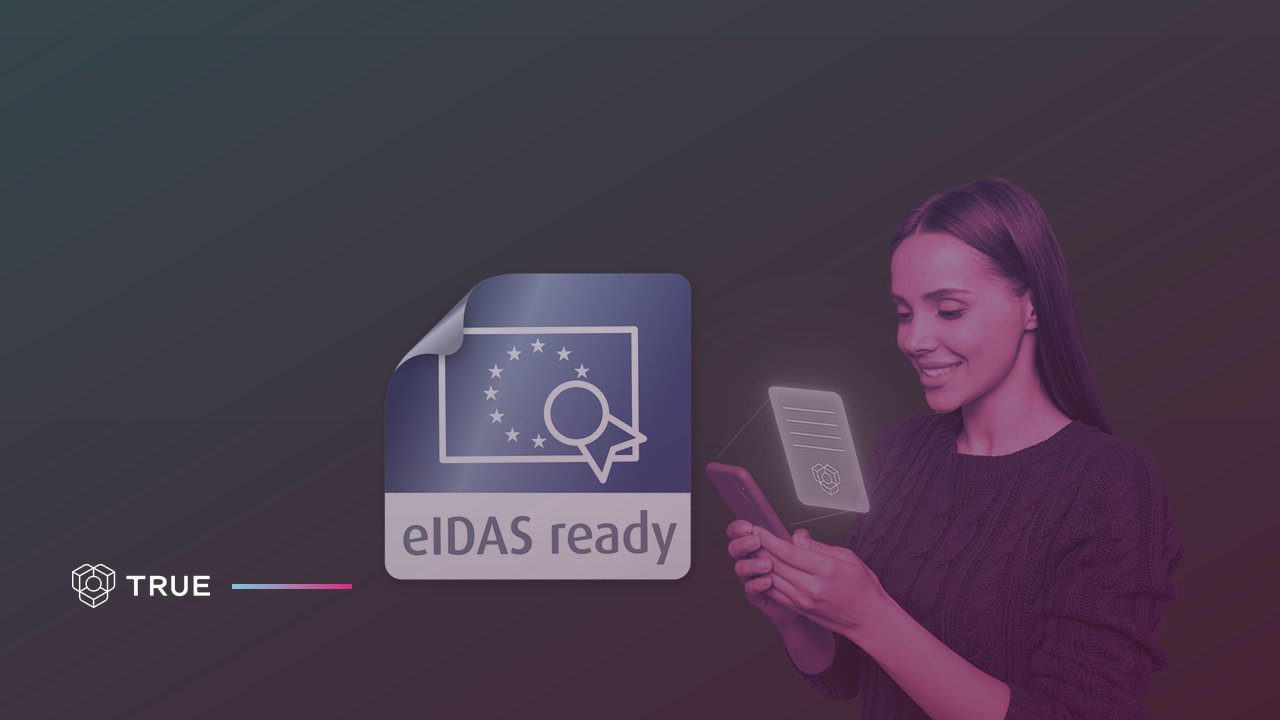
TL;DR: TRUE can now secure university diplomas and transcripts with its own eIDAS qualified electronic seal, making them EDCI/Europass-compatible, recognized across all 27 EU member states, and ready for the EU Digital Identity Wallet. Through Mandated Issue, your institution stays the named issuer while TRUE applies the seal on your behalf, so you need no eSeal of your own. A qualified seal proves a diploma's origin and integrity (it came from your institution and hasn't been altered since); it does not assess the academic content. Today, TRUE offers higher-education institutions eIDAS qualified-sealed, EDCI/Europass-compatible diplomas in bulk.
Yes. An eIDAS qualified electronic seal can be applied to any digital document an organisation issues, from a university diploma to a course certificate, and Article 24a(1) of the eIDAS Regulation recognises it as a qualified seal in all 27 EU Member States. The seal proves that the document comes from the organisation named in it and has not changed since. TRUE Original seals diplomas and transcripts with its own qualified certificate, held since May 2026, and under Mandated Issue the university stays the named issuer.
Two providers stand behind every eIDAS qualified electronic seal: a qualified trust service provider (QTSP) on an EU trusted list issues the qualified certificate for electronic seals, and the organization holding that certificate applies the seal to each certificate or diploma. For university diplomas, TRUE Original is that organization. TRUE Value Software AB seals with its own qualified certificate, held since May 2026, and under Mandated Issue the university stays the named issuer with no eSeal of its own.
The law draws the line. Article 3(27) of the eIDAS Regulation reads: "'qualified electronic seal' means an advanced electronic seal, which is created by a qualified electronic seal creation device, and that is based on a qualified certificate for electronic seal." Article 3(30) adds that the certificate is one "issued by a qualified trust service provider". Article 22(1) obliges each Member State to "establish, maintain and publish trusted lists" of the QTSPs it is responsible for, and Article 20(1) has every QTSP audited "at least every 24 months by a conformity assessment body." Europass sends issuers to the European Commission's trusted list browser to find a trust service provider in their country.
A university can hold a seal certificate itself or let another organization seal on its behalf. The European Commission's Europass guide to issuing European Digital Credentials calls the second route Mandated Issue and names a technology provider among those who can run it: "it may be a technology provider that, from within its system, technically seals credentials issued by its client, e.g. an education and training provider." TRUE Original seals university diplomas this way.
A university diploma needs a qualified electronic seal because a digital file has to prove where it came from, and that nobody changed it, to an employer or university that may sit in another country. An eIDAS qualified electronic seal gives the diploma a legal presumption of both in every EU Member State. Europass, the EU's own credential platform, builds on the seal: "The mandatory application of an eIDAS compliant electronic seal ensures that the credential origin can always be trusted."
A diploma is only worth what it can prove. For decades that proof was a signature, a watermark, and an embossed seal on heavy paper, forgeable by anyone with the right equipment.
That model is under real pressure. Document forgery has moved from back-room print shops to anyone with a laptop, and AI tools make convincing fakes faster and cheaper. Meanwhile employers, foreign universities, and authorities expect verification in seconds, digitally, across borders, not by phoning a registrar's office in another country and waiting for a reply.
Europe's answer points in one clear direction: portable, cryptographically sealed, machine-verifiable credentials a graduate can carry in a digital wallet. For registrars, IT directors, and digitalisation leads, the question is no longer whether diplomas go this way. It's how to get there without standing up a complex trust infrastructure of your own.
The EU is building a wallet for credentials. Under Article 5a(1) of the eIDAS Regulation, as amended in 2024 by Regulation (EU) 2024/1183, "each Member State shall provide at least one European Digital Identity Wallet within 24 months of the date of entry into force of the implementing acts" that the article names. The DC4EU project is already moving diplomas into that wallet in the ELM 3.2 data format.
Three EU initiatives are converging, and together they redraw what a "valid diploma" looks like.
One technical requirement ties all of this together. To be EDCI-compliant, a diploma must be sealed with an eIDAS electronic seal. Europass accepts an advanced or a qualified seal, and TRUE uses the qualified one, the highest level. Without that seal, a credential can be a nicely designed PDF, but it isn't part of the EU's trusted, interoperable, wallet-ready ecosystem. And obtaining and operating a qualified seal is where most institutions hit a wall. (For the full background on the regulation, see how TRUE meets eIDAS standards.)
An eIDAS qualified electronic seal proves origin and integrity: the document comes from the organization named in the seal, and nothing in it has changed since sealing. The seal does not vouch for the grades inside.
This is a trust topic, so precision matters.
A qualified electronic seal is a cryptographic seal, issued under eIDAS by a Qualified Trust Service Provider (QTSP). Under Article 35(2) of eIDAS it "shall enjoy the presumption of integrity of the data and of correctness of the origin of that data to which the qualified electronic seal is linked", and under Article 24a(1) it is recognized as a qualified seal in all 27 EU member states.
A qualified seal proves two things:
It is equally important to be clear about what the seal does not do. A qualified seal is not a review of the content. It does not assess, confirm, or vouch for whether a grade is correct, whether a course was passed, or whether a student earned what the diploma states. Sealing establishes who issued the document and that it is unaltered. The academic facts inside remain the institution's own. The seal carries your authority; it doesn't replace your academic judgment.
One distinction the market blurs constantly: "qualified" is a specific eIDAS term. It sits above an "advanced" electronic seal. Only a qualified seal carries the legal presumption of origin and integrity under eIDAS and is recognized as a qualified seal in every EU member state. (More in the FAQ below.)
TRUE's offering is a qualified seal, a blockchain anchor and EDCI compatibility, in bulk. TRUE Original seals each university diploma with TRUE Value Software AB's own eIDAS qualified electronic seal, anchors it on a public blockchain, and issues a whole graduating cohort in one batch.
As of May 2026, TRUE Value Software AB holds its own eIDAS Qualified Electronic Seal (QSeal) certificate. A qualified trust service provider on an EU trusted list issued it.
That means TRUE can do three things for your diplomas at once:
The result: a beautifully branded diploma that can open on your institution's own domain and carries both EU legal status and a permanent verification anchor.
Opened in the European Commission's own Europass viewer, a TRUE-sealed credential comes back verified. The seal names TRUE Value Software, and the viewer confirms the document has not been altered since it was issued.
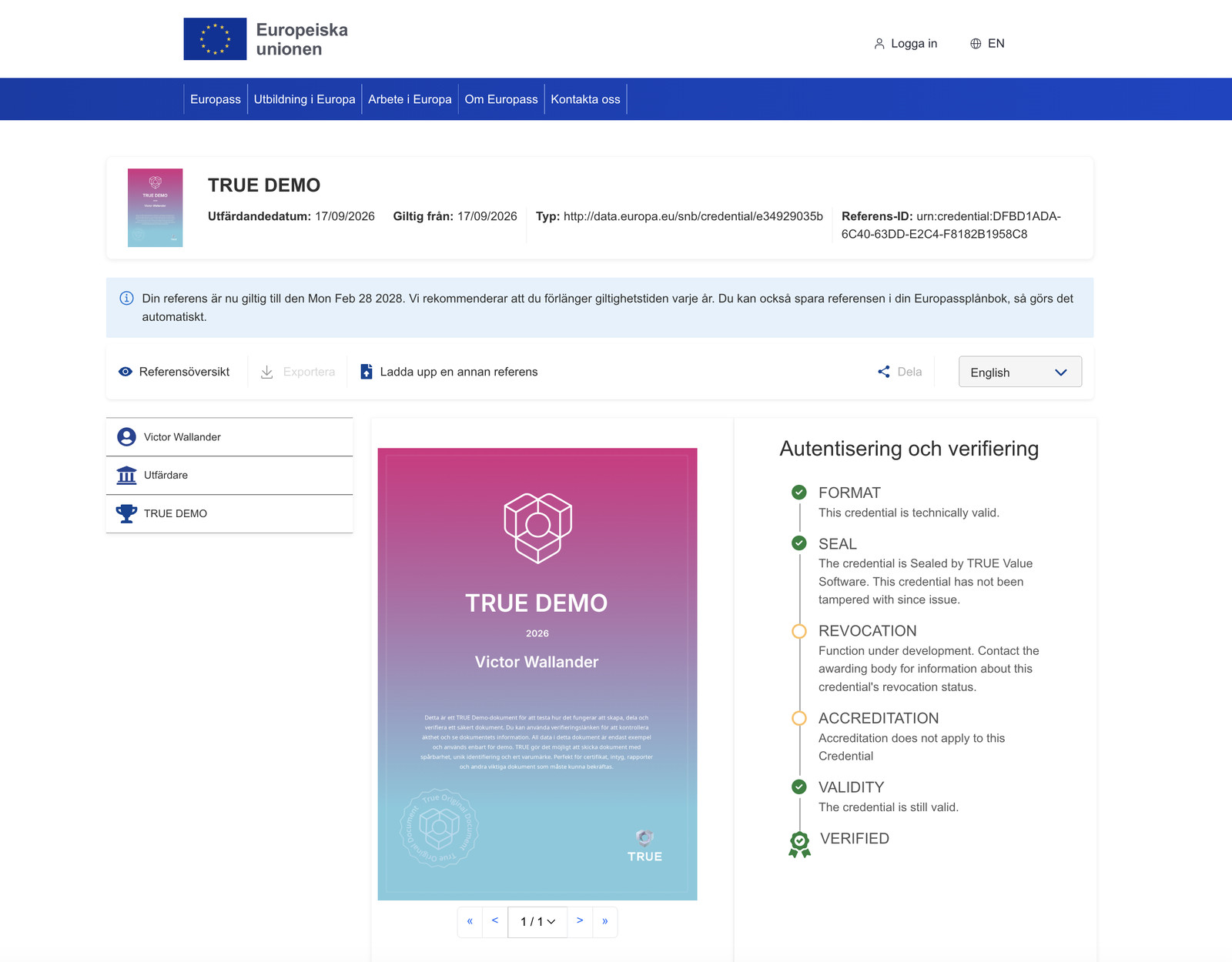
An employer verifies an eIDAS-sealed diploma by opening it in a viewer that validates the seal, such as the European Commission's Europass viewer, which shows who sealed the credential and whether anything changed after sealing. A TRUE-sealed credential opened there comes back verified, with TRUE Value Software named as the sealer.
The check runs by itself. In the words of the Europass guide, "the seal's integrity is instantly and automatically checked every time a credential is viewed", and "the slightest change in the file data will result in a failure of the electronic seal verification check." No phone call to a registrar abroad.
The blockchain anchor is a second, separate check. Anyone can confirm it via QR code or the verification portal, with no account and without asking TRUE or the university. TRUE Verify, TRUE's free verification page, checks documents against their blockchain anchors. The anchor adds a public record. It adds no eIDAS status, which comes from the seal alone. TRUE's guide on how to check if a certificate is real covers the wider routine.
What sets TRUE apart is the combination in one service. TRUE Original seals diplomas with its own eIDAS qualified seal under Mandated Issue, adds a public blockchain anchor, and issues EDCI/Europass-compatible diplomas in bulk, while the university keeps the issuer role and runs no seal, token or HSM of its own.
TRUE offers higher-education institutions eIDAS qualified-sealed, EDCI/Europass-compatible diplomas in bulk, sealed under TRUE's own qualified seal so the university needs no eSeal of its own.
Here is how that compares with the alternatives institutions usually consider.
Sweden's national student-records consortium e-seals diplomas at the advanced level as PDFs: useful shared infrastructure for its member institutions, but not what the EU's wallet ecosystem expects, and not a commercial offering you can buy. International credential platforms like BCdiploma operate commercially but stop short of the qualified seal plus EDCI combination in Sweden, and have no Swedish footprint. Badge and verification platforms, Credly, Accredible, Sertifier, issue digital badges or blockchain-style verification; they're not qualified seal providers, and a badge is not a diploma.
With TRUE, institutions in Sweden have a commercial path to EU-recognized, wallet-ready diplomas today.
You don't build the trust stack. You don't run the seal. You don't wait for a sector consortium to catch up to where the EU is already going. Your institution stays the issuer; TRUE applies the qualified seal; your graduates carry diplomas that work across Europe, today.
Under Mandated Issue, you stay the issuer and TRUE applies the seal. TRUE Original seals each diploma with its own qualified certificate on the university's behalf, and the university remains the named issuer of record. When the awarding and sealing organizations differ, the Europass guide says, "these roles are clearly distinguished in the EDC Viewer".
You might assume that to issue EDCI-compliant diplomas your institution needs its own qualified seal. You don't, and that's the part that changes the economics.
Europass supports a model called Mandated Issue: one organization can issue and seal credentials on behalf of another. Your institution remains the clear, named issuer; TRUE applies the qualified seal under a mandate, with the mandate terms embedded directly in the credential. Anyone verifying the diploma sees your institution as the source.
The flow:
Why this matters in practice: running your own qualified seal means managing Hardware Security Modules (HSMs), certificates, and QSCD tokens: specialist work with real operational risk. One Swedish institution's rollout stalled when its own HSM device locked up. Mandated Issue removes that entire layer. You keep the issuer role and brand; TRUE carries the infrastructure.
With its own eSeal, a university buys a seal certificate from a trust service provider and seals every credential itself. Under Mandated Issue, another organization seals for it. Europass accepts both routes for European Digital Credentials, and TRUE Original runs the second for university diplomas, with the university still named as issuer.
| Question | Your own eSeal | Mandated Issue with TRUE Original |
|---|---|---|
| Who holds the seal certificate? | The university, bought from a trust service provider | TRUE Value Software AB, with its own qualified certificate since May 2026 |
| Who is named as issuer? | The university | The university, with TRUE shown separately as the sealer |
| What does the university need first? | Registration as a legal entity, the main prerequisite Europass names for acquiring a seal | An agreement with the sealing organization, which Europass requires for Mandated Issue |
| What does the university run? | For the Europass EDC Issuer: the seal itself, "as a token or an installed certificate", not a remote sealing service, plus the NexU software, which Europass says runs only on Windows devices | No HSM management, no certificate lifecycle, no QSCD tokens |
| Does a blockchain anchor come with it? | Not as part of the seal | Yes, as a separate layer that does not make the seal qualified |
Neither route asks the university to become a QTSP. A 2025 Open Identity Summit paper, "eIDAS 2.0: Evaluating the Issuance of Digital University Diplomas" by Awid Vaziry, Luca Vetter and Axel Küpper, drew on twelve expert interviews with QTSP executives, conformity assessment specialists and higher-education stakeholders. It found that "becoming a QTSP presents significant challenges for individual institutions, primarily due to security requirements, high operational costs, and complex conformity assessment processes."
The benefits for your institution are legal weight and less work. An eIDAS-sealed diploma carries a presumption of origin and integrity in every EU Member State, and under Mandated Issue the university gets it without running a seal of its own.
This diploma offering extends the same trust foundation behind TRUE Vault to the credential that matters most to a graduate's career.
A university gets started with a demo of eIDAS-sealed diplomas end to end, or with a pilot for a single cohort. Both begin on TRUE's contact page.
The EU's move to wallet-based, sealed credentials is already underway. Institutions that prepare now will hand graduates a diploma that travels: recognized across Europe, verifiable in seconds, ready for the wallet that will soon hold it. You build none of the trust infrastructure: you stay the issuer; TRUE applies the seal.
Book a demo to see eIDAS-sealed diplomas end to end → /contact
Prefer to start small? Contact us for a pilot with a single cohort → /contact
A cryptographic seal issued under the EU's eIDAS regulation by a Qualified Trust Service Provider (QTSP) on the EU Trusted List. It proves two things: the document's origin (it comes from the sealing organization) and its integrity (it hasn't been altered since sealing). Under eIDAS, a qualified seal enjoys a legal presumption of that origin and integrity and is recognized as a qualified seal in all 27 EU member states. It does not assess whether the content inside is correct; it establishes who issued the document and that it is unchanged.
No. Through Mandated Issue, TRUE applies its own eIDAS qualified seal to your diplomas on your behalf, with your institution as the named issuer. You don't need to obtain or operate a qualified seal yourself, and you avoid the technical infrastructure behind it: Hardware Security Modules, certificate management, and QSCD tokens.
EDCI (European Digital Credentials Infrastructure) is the EU's framework and common data format for digital education credentials, so a diploma issued in one member state can be trusted across Europe. Europass is the EU's official platform where graduates store credentials in a personal "My Library." To be EDCI-compliant, a diploma must be sealed with an advanced or qualified eIDAS electronic seal, and TRUE provides the qualified one, the highest level.
Yes. Each diploma carries an eIDAS qualified electronic seal, which is recognized as a qualified seal in all 27 EU member states. Under eIDAS, that seal gives the diploma a legal presumption of origin and integrity, EU-wide.
Both are defined under eIDAS but sit at different trust levels. An advanced seal links the seal to the issuer and detects later changes, but doesn't require a QTSP. A qualified seal is issued via a QTSP on the EU Trusted List, meets stricter requirements, and is the only level that carries a legal presumption of origin and integrity under eIDAS, recognized in all member states. Europass accepts an advanced or a qualified seal for EDCI, and the qualified level is the stronger of the two. "Blockchain-verified" is a separate concept again, not an eIDAS seal of either level.
A model supported by Europass in which one organization issues and seals credentials on behalf of another. TRUE applies its qualified seal to your diplomas under this mandate, while your institution remains the issuer of record. The mandate terms are embedded in each credential, so anyone verifying a diploma sees your institution as the source.
Yes, that's the whole point of the Mandated Issue model. Your institution stays the named issuer of record on every diploma; TRUE simply applies the qualified seal on your behalf under an embedded mandate. To a graduate, an employer, or any verifier, the diploma reads as issued by your university. TRUE never presents itself as the awarding body. It provides the sealing infrastructure behind your authority.
The EU Digital Identity Wallet (EUDIW) is rolling out as the place where citizens hold official credentials, from ID to qualifications. The DC4EU project is already transferring diplomas into the wallet using the ELM 3.2 data format. Diplomas carrying an eIDAS qualified seal that are EDCI-compatible are ready for this shift: graduates can store and present them directly from their wallet. TRUE's sealed diplomas are built for that future today.
It's a seal, and under eIDAS the distinction is precise. A qualified electronic signature is bound to a natural person (an individual). A qualified electronic seal is bound to a legal person (an organization). The signature side, where a named individual signs an agreement, is what TRUE Sign covers. Because a diploma is issued by the institution rather than by one named individual, the correct instrument is a qualified electronic seal: it carries your institution's authority as the issuing body. Both sit at the same "qualified" trust level under eIDAS and both are legally recognized across all 27 EU member states; they simply identify different kinds of issuer. If you've been searching for "qualified electronic signature" for diplomas, the seal is what you actually need, and it's exactly what TRUE applies on your behalf.
A qualified trust service provider on an EU trusted list issues the seal certificate, and the organization that holds it applies the seal. For university diplomas, TRUE Original applies the seal with TRUE Value Software AB's own qualified certificate, held since May 2026, while the university stays the named issuer.
The employer opens it in a viewer that validates the seal, such as the European Commission's Europass viewer, which checks the seal's integrity every time a credential is viewed. A TRUE-sealed credential opened there comes back verified and names TRUE Value Software as the sealer.
In the EU trusted lists. Article 22(1) of eIDAS obliges every Member State to publish a trusted list of the qualified trust service providers it is responsible for, and Europass points issuers to the European Commission's trusted list browser to find one.
Any registered legal entity can: Europass says "any legally registered organisation, institution or company can obtain an electronic seal." A university that would rather not run one can have TRUE Original seal its diplomas under Mandated Issue.
Every organisation we work with started with the same question. Give us thirty minutes and we will show you what your own documents would be worth.
Book a callNot sure where to start? Let us help!
Trusted by leading organisations worldwide