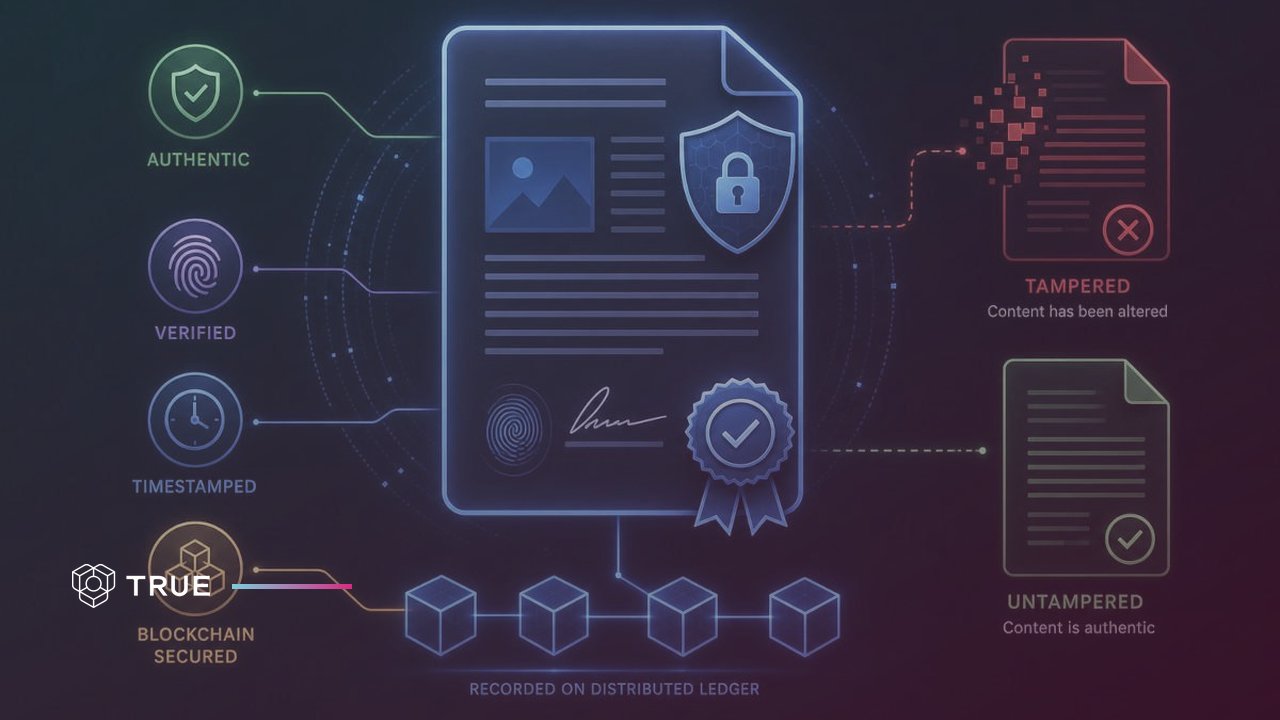
TL;DR: You make a document tamper-proof by recording its cryptographic fingerprint, a SHA-256 hash, at a fixed moment in a record nobody can quietly rewrite, so that any later change shows. In practice tamper-proof means tamper-evident: nobody can stop a copy from being edited, but anyone can prove that it was. TRUE Original does this for certificates, diplomas and licences, TRUE Vault for any file you already have, and TRUE Sign for agreements.
Issue each certificate as a page of its own, with its fingerprint anchored on a public blockchain, so anyone can check it through a link or a QR code and an edited copy fails. A PDF cannot do that, because it can be edited and saved again. TRUE Original issues certificates this way, on the issuer's own domain. Nackademin has issued more than ten thousand diplomas with it, each with a hash on Ethereum, and anyone can check one for free in TRUE Verify.
You make a document tamper-proof in three steps: fingerprint the final file, fix that fingerprint to a time in a record outside your own control, and let anyone compare a copy against it. The fingerprint is a hash such as SHA-256, and the record can be an electronic signature, a trusted time stamp or a blockchain anchor. TRUE Original, TRUE Vault and TRUE Sign all anchor the fingerprint on a public blockchain, so anyone can check a document years later without asking TRUE.
The file offers no protection of its own. A modified PDF looks identical to the original. The "last modified" date in its metadata is a field anyone can rewrite, and most people notice a change for the first time when a dispute starts.
A hash solves half of the problem. SHA-256 turns any file into a 256-bit fingerprint, and changing one comma gives a completely different fingerprint. On its own a hash proves nothing. Anyone can compute one today and claim it matched last year. It becomes evidence once it was recorded, at a known time, somewhere the person who would gain from a change cannot reach.
Every method below differs in one thing: who keeps the record, and who has to be trusted to keep it honest.
A tamper-evident document shows that it has been changed, while a tamper-proof document, in the strict sense, cannot be changed at all. No digital file is tamper-proof in that strict sense, because any file can be copied, edited and saved again. When a supplier or a regulator calls a digital document tamper-proof, the property it can deliver is tamper evidence: any change is detectable and provable.
Two goals hide behind the same word. Prevention tries to stop the edit with password locks and restricted permissions, which slows a casual editor and rarely stops a determined one. Detection proves whether the document changed after a known moment, and it keeps working after the file has left your hands.
Detection is the property the law describes. Under Article 26 of the EU eIDAS Regulation, an advanced electronic signature must be "linked to the data signed therewith in such a way that any subsequent change in the data is detectable." The regulation does not ask for a file nobody can edit. It asks that edits show.
Documents need to be tamper-evident because forged and altered documents are how fraud is hidden. According to the ACFE's Occupational Fraud 2024: A Report to the Nations, which analysed 1,921 fraud cases investigated between January 2022 and September 2023, 28 percent of the fraudsters altered electronic documents or files and 31 percent created fraudulent electronic documents. Paper fared no better in the same report: 37 percent altered physical documents and 41 percent created fraudulent ones.
The cost lands on whoever holds the document when someone disputes it. The finance lead whose audit report a client says read differently. The HR manager looking at a diploma from a candidate. The registrar asked whether a licence is real. None of them can prove a file was never edited by looking at it. They need a record made before the dispute, and for the patterns behind forged papers, TRUE's guide to how document fraud works and how to stop it goes further.
Tamper-evident document signing is electronic signing in which any change to the document after signing breaks the signature or seal, so the edit can be detected. Under Article 25 of the eIDAS Regulation an electronic signature cannot be denied legal effect solely because it is electronic, and a qualified electronic signature has "the equivalent legal effect of a handwritten signature." TRUE Sign makes every signed agreement tamper-evident: it seals the final PDF with a Proof of Signing and anchors the document's fingerprint on a blockchain.
The flow in TRUE Sign is short. The sender uploads a PDF and adds the people who sign it. Each signer opens a personal link and signs on any device, with no account and no app. Signers verify their identity by email, BankID or Freja eID, and the verified name is written into the signature log. Signing with an electronic ID normally produces an advanced signature under eIDAS, which is what TRUE Sign provides, with BankID and Freja eID as the identification methods. When the last signature lands, TRUE seals the file and attaches a Proof of Signing with timestamps, the full event trail and the blockchain-anchored fingerprint.
The proof travels inside the PDF. Anyone holding the signed file can check the seal for free in TRUE Verify, with no login, and a changed file fails verification. That counts years later, when the agreement has been forwarded, renamed and stored in four places and somebody asks which version was signed.
The change that breaks the seal can be a single character. Change one digit in an amount, or delete a space, and the file's fingerprint no longer matches the one sealed when the last signature landed, so the signed PDF fails verification in TRUE Verify. Tamper-evident signing also gives non-repudiation, which NIST defines as "A service that is used to provide assurance of the integrity and origin of data in such a way that the integrity and origin can be verified and validated by a third party". In TRUE Sign that evidence is the verified name in the signature log and the Proof of Signing with the full event trail.
Tamper-evident document binding joins every page of a document to its signature or seal, so a removed, added or swapped page shows. On paper the pages are fastened together physically. In a digital document the fingerprint is calculated over the whole file, so one swapped page changes the hash and breaks the proof.
A forged page cannot hide inside a forty-page contract. One changed digit on page 37 gives a different SHA-256 hash from the one on the chain. TRUE Sign anchors the fingerprint of the complete sealed PDF, signatures included, and TRUE Vault binds any file, of any length, to a single fingerprint.
You create a tamper-evident PDF for legal compliance by signing or sealing the final version and fixing its fingerprint to a time in a record you do not control, so any later edit breaks the proof. A password lock does not do this: it restricts editing in readers that honour it and proves nothing about whether the content changed. TRUE Vault turns any existing PDF into a tamper-evident record with a permanent proof URL in about thirty seconds, and TRUE Sign produces sealed, tamper-evident PDFs for anything that needs a signature.
EU law sets a floor and a ceiling for electronic evidence. Under Article 41 of eIDAS, an electronic time stamp "shall not be denied legal effect and admissibility as evidence in legal proceedings solely on the grounds that it is in an electronic form", nor because it is not qualified. A blockchain-anchored timestamp is widely treated as evidence of when a file existed in a specific form. A qualified electronic time stamp from a qualified trust service provider goes further. It "shall enjoy the presumption of the accuracy of the date and the time it indicates and the integrity of the data to which the date and time are bound."
In the EU, blockchain timestamping increasingly sits alongside eIDAS qualified timestamps. TRUE combines the two layers. For issuers that need EU legal status, TRUE pairs an eIDAS qualified electronic seal, issued through a qualified trust service provider on the EU Trusted List, with a blockchain anchor that anyone can check. The seal carries the legal status and the anchor carries independent, permanent verification, as TRUE's article on blockchain timestamps and eIDAS qualified timestamps sets out.
Companies create tamper-proof cryptographic records of customer authorisations by having the customer sign the authorisation with a verified identity, hashing the signed record, and anchoring the hash with a time in a record the company itself cannot rewrite. The identity step answers who agreed. The anchored hash answers what they agreed to, and when. With TRUE Sign the customer verifies by email, BankID or Freja eID and the authorisation comes back as a sealed PDF with its Proof of Signing, and with TRUE Vault any authorisation record, log or export gets its own permanent proof URL.
The weak point of most authorisation records is the database they sit in. Anyone with administrator access can edit an entry in the company's own system, and a customer who disputes a consent, a mandate or a quote knows it. A fingerprint anchored on a public blockchain sits outside that system, where neither the company nor an intruder in its servers can change it afterwards.
The dispute then turns on arithmetic. Say a customer insists the quote was for 40 hours and the company says 80. Both sides hold a PDF. Only one of them produces the fingerprint written to the chain on the day the quote was approved.
You create tamper-proof records by fixing each record's fingerprint at the moment the record is written, in a place its owner cannot rewrite, and by saving every later change as a new version instead of an overwrite. TRUE Vault does this for any file: it computes the SHA-256 hash, anchors it on a public blockchain with the exact date and time and returns a permanent proof URL, in about thirty seconds.
The US National Institute of Standards and Technology sets the same goal for audit logs in control AU-9 of SP 800-53: "Protect audit information and audit logging tools from unauthorized access, modification, and deletion." Its enhancement AU-9(3) reads: "Implement cryptographic mechanisms to protect the integrity of audit information and audit tools." A fingerprint anchored on a public blockchain is a cryptographic mechanism of that kind, kept outside the system that writes the records.
You keep tamper-proof records by fingerprinting each record, or each day's export, when it is created and anchoring the fingerprint with a time, so a later edit to any entry shows and every earlier version stays provable. Regulators already ask for the property underneath. The US FDA rule for electronic records, 21 CFR 11.10(e), requires "secure, computer-generated, time-stamped audit trails" and states that "Record changes shall not obscure previously recorded information."
TRUE Vault works record by record. A laboratory can anchor an experiment record on the day it is written, and a compliance team can anchor each daily export of a log. When a record is updated, the new version gets its own proof and the old proof URL stays valid, proving the earlier version existed. Three years later a regulator does not have to take the company's word, or its software provider's word. The regulator checks the files against the public record directly.
The same method proves an email or a piece of creative work: see how to prove an email was sent and not altered and how to prove you created something first.
Tamper-proof certification means issuing certificates, diplomas and licences that anyone can check against the issuer's own record, so an edited or invented copy fails the check. A PDF certificate is a file like any other and can be edited like one, so the proof has to live outside the file. TRUE Original issues certificates, diplomas and licences as TRUE Original documents, secured on a blockchain and verifiable by anyone through a link or the QR code on a printed copy.
A TRUE Original document lives online, on the issuer's own domain, with verification built in. Anyone can verify it by clicking the button next to the document on the web, or by scanning the QR code on a paper copy with a phone camera. No app is required. TRUE Original is eIDAS compliant, founded in Sweden in 2020, and has secured 900,000+ documents for 200+ organizations across 15+ countries.
Patrik Slettman, co-founder of TRUE Original, puts it this way: "So we built documents that cannot be forged. Nobody has to take our word for it. The document proves itself." For an issuer that means a recipient, an employer or a regulator checks the diploma or licence against the issuer, not against a file someone forwarded. The differences from a PDF are set out in paper, PDF or TRUE Original document, and the record underneath in what blockchain certificates are.
Permanent verification needs a proof that outlives the platform storing the file, so the strongest options anchor each document's fingerprint on a public blockchain instead of keeping the proof in their own database. TRUE Vault does this for files you already have, from contracts to reports, and returns a permanent proof URL in about thirty seconds. TRUE Original does it for the certificates, diplomas and licences it issues. The proof sits on a public blockchain, not on TRUE's servers, so the record outlives any vendor, TRUE included. Anyone can check a file in TRUE Verify for free.
A blockchain makes a document tamper-proof by holding the document's hash, with the time it was written, in a public ledger that no single company controls. The chain is run by thousands of nodes worldwide. Anyone with the file can compute its SHA-256 hash and compare it with the ledger entry: a match means the file is unchanged, a mismatch means it was changed. TRUE anchors fingerprints on several public blockchains, among them Ethereum and Polygon, and a customer who wants a specific chain can have it.
The file itself can stay private. Only the hash is written to the chain, and a hash reveals nothing about the contents. TRUE Vault does not keep a file's bytes once the hash is computed and anchored. The proof URL that TRUE Vault returns can be made public, kept out of search engines or protected with a password.
Permanent. Records cannot be deleted or backdated. A timestamp from 2026 will still be checkable in 2046.
The proof lives on the blockchain itself, not on TRUE's servers. Even if the TRUE Vault app disappeared tomorrow, every proof link would still work and anyone could still verify the files. If TRUE Original disappeared tomorrow, the record would still be there, and verification would still work. A blockchain anchor works like a trusted time stamp in which the trusted authority is replaced by open infrastructure, and it sits beside eIDAS signatures and qualified seals rather than replacing them. TRUE Vault anchors a file's SHA-256 fingerprint this way in about thirty seconds from upload to proof URL, and anyone can check the file against it in TRUE Verify with no account and no cost.
TRUE Vault makes an existing file tamper-proof by hashing it, anchoring the hash on a blockchain at an exact date and time, and returning a permanent proof URL that anyone can check. It takes about thirty seconds from upload to proof URL. TRUE Vault takes any file, from a PDF or a scan to a photo, an exported email or a webpage, and it is free to start.
TRUE Vault proves three things: this exact file existed on this exact date, not a byte has changed since it was anchored, and the file is tied to a verified TRUE Vault account. Update the document later and TRUE Vault keeps every version, each with its own proof. Start at trueoriginal.com/vault or read how TRUE Vault works.
Electronic signatures, trusted time stamps and blockchain anchors all make a document tamper-evident, while password-locked PDFs and cloud version history give no independent proof. The methods differ in who has to be trusted to keep the record honest: a certificate authority, a time-stamping authority, a cloud provider, or a public blockchain that nobody owns. Most organisations get the strongest result by combining a signature for identity with a blockchain anchor for long-term, independent verification.
PDF readers offer password protection and edit restrictions. They deter casual editing, but they are not integrity controls. A locked PDF can be opened in software that ignores the restrictions, saved again and passed on. The lock proves nothing about whether the contents are unchanged.
A qualified electronic signature under eIDAS binds a signer's identity to a document cryptographically, and if the document changes after signing, the signature breaks. Public key infrastructure sits underneath: certificates from certificate authorities confirm who signed, with a chain of trust up to root authorities that browsers and operating systems already trust. The trust model is institutional. If a CA is compromised or distrusted, every certificate it issued comes under question. If a signing certificate is revoked or expires, or the trust service provider leaves the market, long-term verification depends on validation data kept for the purpose.
A hash function such as SHA-256 is the building block under almost every method here. On its own, a hash proves nothing about the past. It needs an independent record of when it existed.
A time-stamping authority signs a file's hash together with the time, producing a token that proves the file existed in that form at that moment. RFC 3161 tokens are standards-based and widely used in regulated industries, and eIDAS qualified time stamps carry a legal presumption of accuracy and integrity. An eIDAS qualified timestamp from a qualified trust service provider gives the same proof with EU-wide legal recognition. TRUE Vault binds a file's SHA-256 fingerprint to a date and time on a public blockchain instead, so its proof does not rest on one authority's signing certificate.
Weakness: Relies on the TSA staying in business and remaining trusted. A TSA that ceases operation creates the same long-term verification headache as expired signing certificates.
Google Drive, SharePoint, Dropbox and similar services keep version histories, which help with everyday recovery. In a dispute the history is only as independent as the provider running the server, and only someone with access to the account can see it.
| Method | Detects tampering? | Independent verification? | Permanent? | Requires trust in vendor? |
|---|---|---|---|---|
| Locked PDF | No | Nobody independently | No | The reader that honours the lock |
| Digital signature (eIDAS QES) | Yes | Yes (during cert validity) | Limited | Yes (CA) |
| Trusted time stamp (RFC 3161) | Yes | Anyone with the token | While TSA exists | Time-stamping authority |
| Cloud version history | Partly | Account holders | While the account exists | Cloud provider |
| Blockchain anchor (TRUE Original, TRUE Vault, TRUE Sign) | Yes | Anyone with the file, no account | Yes, on a public blockchain | No single party |
A tamper-evident record settles disputes about which version of a document existed at a given time. Only one file matches the fingerprint recorded on the day, and anyone can run the check. A TRUE Vault anchor or a TRUE Sign seal turns an argument about memory into a comparison of two hashes.
You delivered an audit report in the first quarter. In the third, the client claims the figures supported a different conclusion. With the report anchored in TRUE Vault on delivery day, the file you sent is identical, byte for byte, to the anchored file. One fingerprint, one answer.
Two parties produce two slightly different PDFs, each claiming theirs is the signed one. If the contract was signed in TRUE Sign or anchored at signing, the dispute ends quickly: only one file matches the record on the chain.
Minutes were circulated, approved and filed. Six months later a former director claims a resolution was reworded. The approved version was anchored on the day it was filed. The version being challenged either matches the chain or it does not.
Record the document's SHA-256 fingerprint at a fixed time in a record nobody can quietly rewrite, such as an electronic signature, a trusted time stamp or a blockchain anchor, so any later change gives a different fingerprint and shows. TRUE Original, TRUE Vault and TRUE Sign anchor that fingerprint on a public blockchain, so anyone can check the document without asking TRUE.
A tamper-evident document shows that it has been changed, while a strictly tamper-proof document cannot be changed at all. No digital file can be made impossible to edit, so a tamper-proof digital document is in practice a tamper-evident one whose proof cannot be removed.
Yes. Anchor the finished PDF's fingerprint with a time, for example in TRUE Vault, which gives the file a permanent proof URL in about thirty seconds, and from then on anyone can check whether a copy matches the anchored version. A password lock alone does not make a PDF tamper-proof.
Tamper-evident document signing is electronic signing in which any change to the document after signing breaks the signature or seal. Article 26 of the EU eIDAS Regulation requires an advanced electronic signature to be linked to the signed data so that any subsequent change is detectable. TRUE Sign seals each signed PDF with a Proof of Signing and anchors its fingerprint on a blockchain.
Companies have the customer sign the authorisation with a verified identity, hash the signed record and anchor the hash with a time in a record the company itself cannot rewrite. In TRUE Sign the customer verifies by email, BankID or Freja eID, and the authorisation comes back as a sealed PDF with a Proof of Signing.
Compare the document's fingerprint with the one recorded when it was issued, signed or anchored. For TRUE documents and sealed PDFs, paste the link, the document ID or the PDF into TRUE Verify, which is free and needs no account, or scan the QR code on a printed TRUE Original document.
Fingerprint each record when it is written, anchor the fingerprint with a time outside your own systems, and save every change as a new version with its own proof. TRUE Vault anchors a file's SHA-256 hash on a public blockchain and returns a permanent proof URL that anyone can check in TRUE Verify.
Non-repudiation means that a third party can verify the integrity and origin of signed data, so the signer cannot later deny it, as NIST defines the term. In TRUE Sign the evidence is the verified name in the signature log and the Proof of Signing with the full event trail.
TRUE Original, Stockholm. Secure digital documents since 2020. eIDAS compliant. 900,000+ documents secured for 200+ organizations across 15+ countries.
Every organisation we work with started with the same question. Give us thirty minutes and we will show you what your own documents would be worth.
Book a callNot sure where to start? Let us help!

Trusted by leading organisations worldwide