TL;DR: Blockchain secures a document by recording the document's cryptographic fingerprint on a public blockchain at the moment of issue, so anyone can later check whether the document still matches that record. TRUE Original is blockchain-agnostic: it anchors documents on several public blockchains, among them Ethereum and Polygon, and a customer who wants a specific chain can have it. TRUE Original has issued over 900,000 documents for 200+ issuers in 15+ countries.
Blockchain is used to secure documents by writing a cryptographic fingerprint of each document, called a hash, to a public blockchain when the document is issued. The document itself stays off the chain. Anyone who later holds the document can calculate the fingerprint again and compare it with the record on the blockchain.
With TRUE Original the method makes a document tamper-evident in four steps:
Amazon Web Services describes the same pattern. "Instead, we use blockchain as a notary service, storing proofs of documents," Christoph Niemann wrote on the AWS Web3 Blog on 9 May 2022, and "The document itself is stored off-chain" (AWS, Notarize documents on the Ethereum Blockchain). The blockchain plays the notary's part. It records that a given fingerprint existed at a given time, and anyone can consult the record.
The idea is older than any blockchain. In 1991 the Journal of Cryptology published a paper by S. Haber and W.S. Stornetta titled "How to time-stamp a digital document". The Bitcoin paper, signed Satoshi Nakamoto, cites that work and describes the method in one sentence:
"A timestamp server works by taking a hash of a block of items to be timestamped and widely publishing the hash, such as in a newspaper or Usenet post." (Satoshi Nakamoto, Bitcoin: A Peer-to-Peer Electronic Cash System)
A public blockchain took the place of the newspaper. The hash goes into a block that is copied across many independent computers, and every new block refers back to the one before it.
TRUE Original writes the SHA-256 hash of each document to a public blockchain. The US National Institute of Standards and Technology defines SHA-256 in its Secure Hash Standard and states the property that matters for a diploma or a licence:
"Any change to a message will, with a very high probability, result in a different message digest." (NIST, FIPS 180-4, Secure Hash Standard)
A SHA-256 fingerprint is 256 bits long, written as 64 characters, whether the document has one page or two hundred. Change one letter in a graduate's surname and the fingerprint comes out different. The steps are laid out one by one in how blockchain certificates work.
A blockchain check shows whether a document is identical to the one the issuer anchored, and when the issuer anchored it. A match means the document has not changed since issue. An edited or forged copy can look perfect, but it has no matching fingerprint on the chain, so the check fails.
Picture a hiring manager in Malmö holding a diploma from a school she has never heard of. She scans the QR code on the TRUE Original document, or pastes its link, its document ID or the PDF into TRUE Verify. TRUE Verify needs no account and returns a security level rating in seconds.
The school's registrar never hears about it.
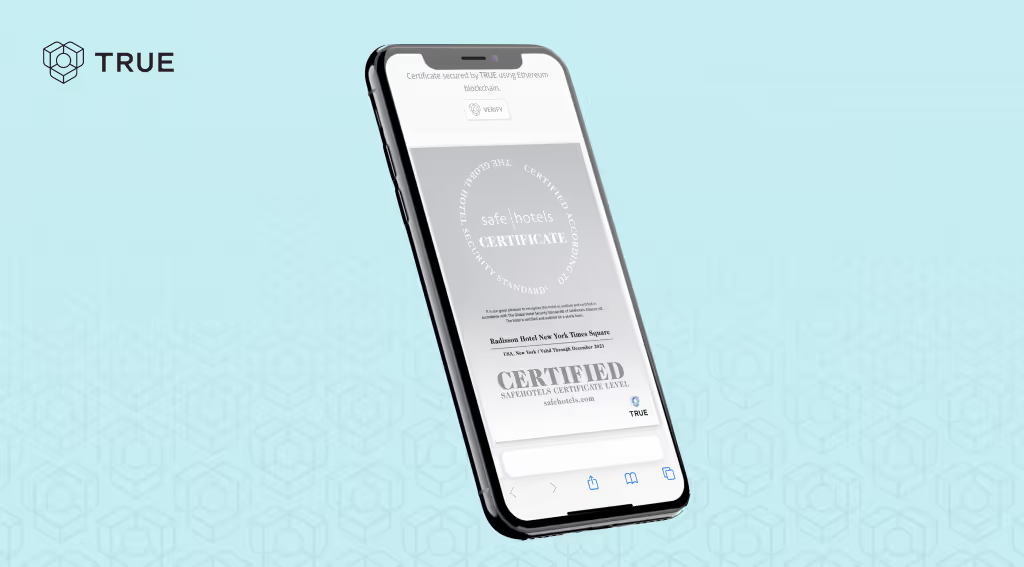
The answer is worth trusting because of where the record lives. A fingerprint on a public blockchain sits on a ledger that no single company controls, TRUE included, so not even the issuer can quietly rewrite it. A convincing design does not help a forger either, because the check compares fingerprints, not appearances. More in how blockchain catches an AI-made fake certificate.
TRUE Original uses several blockchains so that the organisation issuing a document, rather than a single network, decides where its proof lives. TRUE is blockchain-agnostic: TRUE Original anchors documents on several public blockchains, among them Ethereum and Polygon, and a customer who wants a specific chain can have it.
When TRUE launched in Stockholm in 2020, Ethereum was its blockchain. A well-known public chain gave the first TRUE documents a foundation that anyone could look up. In the years that followed, faster and cheaper public chains matured, and TRUE added them instead of tying every customer to one. It worked well to start with a well-known blockchain to create a trusted foundation for the technology, but as Ethereum got competition from faster and cheaper blockchains it made sense to expand and use more than one.
Today TRUE uses four different blockchains to store the meta of its clients' secure documents: Ethereum, AVAX, Fantom and Polygon. AVAX, Fantom and Polygon are the recent additions, and Polygon, with its carbon-neutral mission, is the latest. These are 'greener' alternatives and use far less energy than Ethereum (pre-fork). TRUE continuously looks at smart technology and will add more blockchain options in the future. Together these chains secure digital certificates, diplomas, awards, licences, memberships and more as TRUE Original documents.
An organisation can have its own reasons to prefer a chain, such as an IT policy that names a network or a sustainability target. TRUE Original anchors that organisation's documents on the public chain it wants. Recipients see no difference. Their TRUE documents open on the issuer's own website, with the same link, the same QR code and the same check in TRUE Verify.
Using several blockchains keeps an issuer's documents independent of any one network's fees, speed and future decisions. Each public blockchain is run by its own community, which can change the rules, and an issuer whose provider works with several chains can anchor its next document wherever its needs are best met.
Ethereum shows how large such a change can be. On September 15, 2022, Ethereum moved from proof-of-work to proof-of-stake in an upgrade called The Merge. According to ethereum.org, The Merge reduced Ethereum's energy consumption by about 99.95%.
A diploma is meant to be checked for decades. Over decades a public blockchain can change its fees, its speed and its rules, as Ethereum did in 2022. A blockchain-agnostic provider lets the issuer follow those changes without changing how anyone checks its documents.
The best blockchain for securing documents is a public one that anyone can read without permission and that has a long public track record. Ethereum and Polygon, two of the public blockchains TRUE Original uses, both fit that description, and TRUE Original lets each customer choose the chain that suits its own policies.
Ethereum is the older of the two. Its first live release, Frontier, launched on July 30, 2015, according to ethereum.org's history of Ethereum. The Ethereum developer documentation says that "blocks are only created and committed on Ethereum once every twelve seconds". Each new block contains a reference to its parent, so every later block builds on the one that holds a fingerprint recorded today.
Ethereum is a decentralised, open-source blockchain with smart contract functionality. Ether is the native cryptocurrency of the platform, and among cryptocurrencies Ether is second only to Bitcoin in market capitalisation. Ethereum allows anyone to deploy permanent and immutable decentralised applications onto it, with which users can interact. Decentralised finance applications provide a broad array of financial services without the need for typical financial intermediaries like brokerages, exchanges or banks, such as allowing cryptocurrency users to borrow against their holdings or lend them out for interest.
Ethereum also allows users to create and exchange NFTs, which are unique tokens representing ownership of an associated asset or privilege, as recognised by any number of institutions. Many other cryptocurrencies use the ERC-20 token standard on top of the Ethereum blockchain and have used the platform for initial coin offerings.

Polygon is built to work alongside Ethereum. The Polygon documentation describes its PoS chain as an "EVM-compatible Proof-of-Stake sidechain for Ethereum". Polygon also reports back to Ethereum. According to the Polygon architecture documentation, its validation layer gathers Polygon's blocks into Merkle trees and "publishes the Merkle root periodically to Ethereum". Polygon calls these snapshots checkpoints.
Polygon has created a leading blockchain network. Its vision follows that of the Satoshi standard, one of complete decentralisation. It does this by using validators distributed worldwide, many of whom are security experts, and their job is to monitor and improve the security and resilience of the network. They are able to identify vulnerabilities and feed them back to Polygon, which can make quick updates.
Using Polygon, developers can build Ethereum-compatible blockchain networks and scaling solutions. Polygon's framework is based on Proof of Stake, where miners are rewarded for staking their holdings rather than by using huge amounts of energy to mine, as is the case with Proof of Work chains like Bitcoin.
A Polygon block that holds a document's fingerprint is therefore also covered by a checkpoint recorded on Ethereum.
Avalanche (AVAX) and Fantom are public smart-contract blockchains, and together with Polygon they are TRUE's recent additions alongside Ethereum. Avalanche was launched in September 2020 by Ava Labs, a team based in New York. Ava Labs has raised nearly $300 million in funding, and the Avalanche Foundation has completed private and public token sales totalling $48 million.

As blockchain technology develops, it provides new solutions to old problems of scalability, interoperability and usability. Avalanche has taken a unique approach using three separate blockchains in its primary platform. Avalanche is powered by its own token AVAX and several consensus mechanisms, and claims to be "the fastest platform for smart contracts in the blockchain industry, if you measure from start to finish".
Fantom is a high-performance, scalable, EVM-compatible and secure smart-contract platform. Fantom's mainnet deployment, Fantom Opera, is built on Fantom's consensus mechanism, Lachesis. Fantom is a leaderless, asynchronous and byzantine fault-tolerant Layer 1 blockchain protocol. Lachesis enables Fantom to deliver fast transaction speeds, low transaction costs and deterministic finality, while remaining permissionless, decentralised and open-source.
The advantages brought by Fantom are not merely performance: its modular architecture allows for customisation of blockchains for digital assets, with different characteristics tailored to different use-cases. Fantom also offers high levels of security by using a leaderless Proof-of-Stake protocol to secure the network.
No. A blockchain record shows that a document has not changed since its fingerprint was anchored, and when that happened, while an eIDAS qualified electronic seal is a separate legal mechanism under EU law. TRUE Original offers both: TRUE Value Software AB holds its own eIDAS qualified electronic seal certificate, and the qualified seal is a separate layer from the blockchain anchor.
The seal matters for diplomas that need legal weight across the EU. TRUE has written up whether a blockchain timestamp is valid under eIDAS and how eIDAS-sealed university diplomas work.
Yes. An organisation that issues documents with TRUE Original can have them anchored on a specific public blockchain, because TRUE is blockchain-agnostic. The organisation issues the same way whatever the chain: from the TRUE dashboard, through a REST API with five endpoints, by sending a structured email, or from Canvas LMS, Moodle, Learnster and Salesforce.
Nobody at the organisation writes a blockchain transaction. A course coordinator sends one structured email, and the TRUE document is issued, designed, anchored and published on the organisation's own domain. Developers find the five endpoints on the TRUE API page, and the case for the address is in why certificates belong on your own domain. An organisation that wants a particular chain can contact TRUE, also to learn more about how to create value for the organisation with secure documents.
TRUE cares about creating smart solutions for its customers which are highly secure, easy to use and at a good cost, and wants its technology to be sustainable and versatile. Because of this TRUE is always looking for better solutions, and it has discussions with owners of other chains so that it can continue to offer the latest and best for its customers.
TRUE Original has issued over 900,000 documents this way, for 200+ issuers in 15+ countries.
Blockchain secures a document by recording the document's SHA-256 fingerprint on a public blockchain when it is issued. Anyone can later calculate the fingerprint again: a match shows the document is unchanged since issue, and an edited or forged copy fails the check.
TRUE Original calculates the SHA-256 fingerprint of each document when it is issued and writes it to a public blockchain, among them Ethereum and Polygon. Anyone can then check the document in TRUE Verify, which compares it with that record: a match shows the document is unchanged since issue.
No. Blockchain secures a document by recording its cryptographic fingerprint, and the document itself stays off the chain; Amazon Web Services describes the pattern as using blockchain as "a notary service, storing proofs of documents". TRUE Original writes the SHA-256 hash of each document to a public blockchain.
TRUE Original is blockchain-agnostic, so an issuer's proof does not depend on one network. TRUE Original anchors documents on several public blockchains, among them Ethereum and Polygon, and a customer who wants a specific chain can have it.
The best blockchain for securing documents is a public one that anyone can read without permission and that has a long public track record. Ethereum has run since July 30, 2015, and Polygon publishes checkpoints of its blocks to Ethereum; TRUE Original uses both, among other public blockchains.
Yes. A customer that wants its documents anchored on a specific public blockchain can have it, and recipients and verifiers check the documents the same way, by link, QR code or TRUE Verify.
A blockchain check shows whether a document is identical to the one the issuer anchored, and when it was anchored. A forged or edited copy has no matching fingerprint on the chain, so the check in TRUE Verify fails, free and without an account.
No. A blockchain record shows that a document is unchanged since it was anchored, while an eIDAS qualified electronic seal is a separate legal mechanism. TRUE Value Software AB holds its own eIDAS qualified electronic seal certificate, and TRUE Original offers the seal as a separate layer from the blockchain anchor.
Every organisation we work with started with the same question. Give us thirty minutes and we will show you what your own documents would be worth.
Book a callNot sure where to start? Let us help!

Trusted by leading organisations worldwide