TL;DR: A digital badge is an online record of a skill, achievement or membership: an image plus data on who earned it, who issued it and what it took. The open standard for digital badges is Open Badges, maintained by 1EdTech, and over 320 million badges were awarded through the 24 platforms in 1EdTech's 2025 Badge Count. TRUE Original issues each badge as a blockchain-secured TRUE document on the issuer's own domain, so anyone can check it in TRUE Verify.
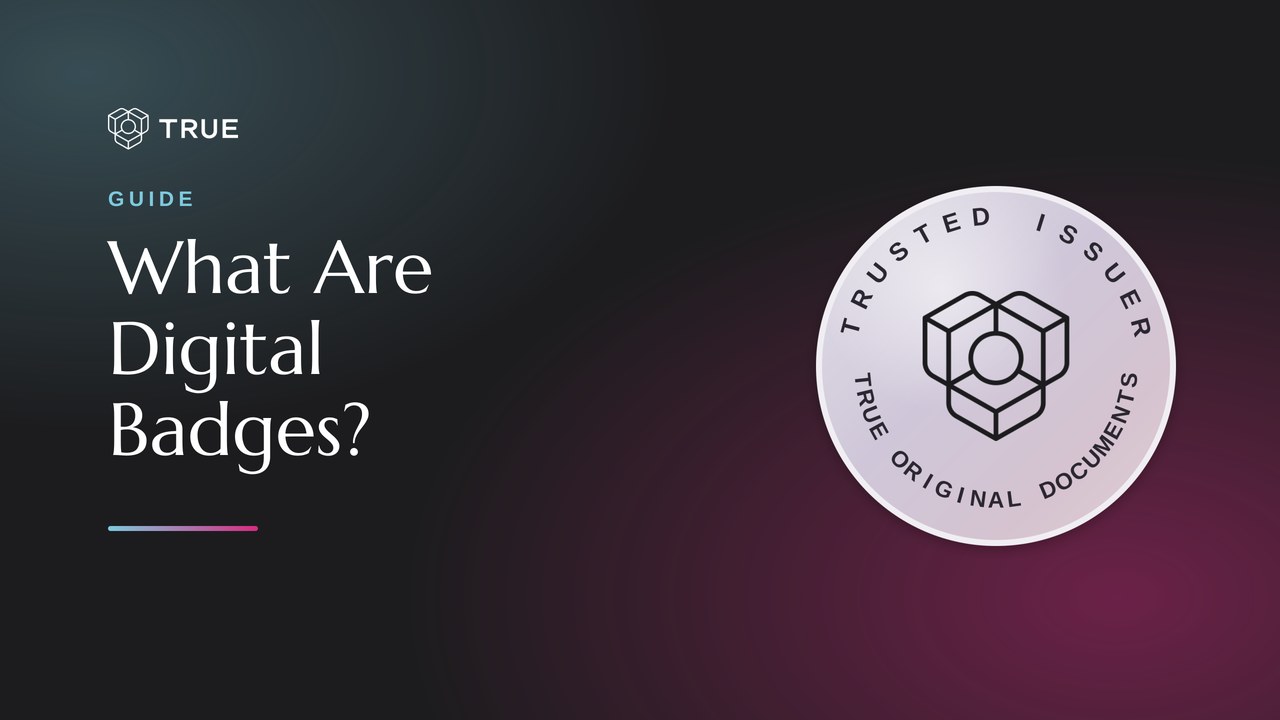
A digital badge is a verifiable online record of a skill, achievement or membership, made of an image and the data behind it: who earned it, who issued it and the criteria that had to be met. Digital badges, also called credential badges, are shared on LinkedIn, in email signatures, on websites and in digital CVs.
The standards body 1EdTech, which maintains the Open Badges specification, defines the format this way:
"1EdTech's Open Badges specification describes a method for packaging information about a single recognition or achievement, such as an earned microcredential, skill, competency, or degree." (1EdTech, Open Badges)
The picture is the part people see. The data is the part that proves anything. 1EdTech describes an Open Badge as a visual token with "a rich, defined metadata structure", and the image itself, a PNG or SVG file, can carry that data.
One badge stands for one achievement. A diploma covers a whole programme and a certificate usually covers a course; how the three differ is set out in certificate vs diploma vs badge.
A digital badge recognises one skill or achievement, while a certificate covers a whole course or training. A badge is built to be shown on a profile, in an email signature or on a website, and a certificate is the fuller record of what was completed. TRUE Original issues both from one platform, and a TRUE Original badge links to the TRUE document behind it, so the badge and the certificate carry the same blockchain proof.
| Feature | Digital badge | Certificate | Diploma |
|---|---|---|---|
| Covers | One skill or achievement | One course or training | A structured programme |
| Typical time to earn | Minutes to hours | Hours to weeks | Months to years |
| Usually issued by | Platforms, employers and communities | Training providers, employers and associations | Educational institutions and academies |
A digital badge works by tying an image to data that a computer can check. The issuer defines an achievement and its criteria, awards the badge to a named earner, and the earner shares a link or a file that anyone can open to see who issued it and why.
The Open Badges standard began at Mozilla, which released the public beta of its Open Badge Infrastructure in October 2012. 1EdTech became responsible for the specification on 1 January 2017. In the current version, Open Badges 3.0, each badge "is digitally signed by its issuing organization as Verifiable Credentials compatible with the Verifiable Credentials Data Model 2.0", according to 1EdTech.
A badge image on its own proves nothing. Anyone can right-click a PNG and save it, and a copied badge looks exactly like an earned one. The difference is the record behind the image, and whether a stranger can check it without asking the issuer.
A TRUE Original badge works the same way from the earner's side, with the proof in a different place. TRUE Original links every badge to a TRUE document, such as a diploma, a certificate, a licence or a membership, and anchors a fingerprint of that document on a public blockchain at the moment of issue. The information on the Document can never be altered after it has been issued, and this makes both the Badge and the Document (certificate, diploma, credential) verifiable as authentic. They are naturally more secure, valuable and trusted. TRUE is blockchain-agnostic: TRUE Original uses several public blockchains, among them Ethereum and Polygon, and a customer who wants a specific chain can have it. How the Open Badges format and a blockchain-secured TRUE document compare is covered in Open Badges vs digital certificates.
Digital credentialing is the practice of issuing qualifications, licences, memberships and achievements as verifiable digital records instead of paper or PDF files. A digital credential is the record a person receives, and digital credentialing is the process an organisation runs to issue, share and check those records. TRUE Original runs that process for certificates, diplomas, licences, memberships and badges. According to 1EdTech's Badge Count 2025, the badge platforms that took part reported over 320 million badges awarded, up from nearly 75 million in the 2022 count.
The two counts are not a like-for-like comparison. The number of reporting platforms rose from 15 to 24 between 2022 and 2025, and global platforms were included for the first time, as 1EdTech notes in its announcement of 11 December 2025.
The 2025 respondents reported over 1.7 million different badges on offer and over 97,000 organisations issuing them, a figure 1EdTech says may count some issuers twice.
Digital badges are used most often to show that someone can do something. In the Badge Count 2025 results, "Demonstrating a skill or competency" was the most common use, selected by 90% of badge platforms, followed by short micro-credentials (81%) and obtaining or renewing a certification (62%).
Certifying bodies such as national associations and trade associations issue badges to highlight trusted vendors, members or partners, and to show compliance or an accreditation. The Swedish Association of Vocational Colleges (YHF) issues membership badges through TRUE Original. The badge below was given to Hyper Island College.
TRUE-badges can be automatically generated with a Recipient's name on them. It is very useful for Memberships, Licenses, Awards and Diplomas. TRUE Original badges can also be high-resolution images or animated GIFs, for issuers who want a badge that moves. This one from RFSL Utbildning opens the certificate behind it:
Digital badges for employees are badges that an employer or an industry body awards to staff for completed training, certifications, licences or internal programmes, which the employee can show on LinkedIn, in an email signature or in a CV. According to 1EdTech's Badge Count 2025, employers issue badges through 62% of the 24 platforms surveyed, and so do industry associations.
For the employee, the badge turns a line on a CV into a link a recruiter can open. Asked how earners share their badges, the platforms in the same survey named social media most often (74%), then digital wallets (68%) and email (37%). 26% named CVs with the badge embedded by URL or QR code, and 26% named job boards and applicant tracking systems.
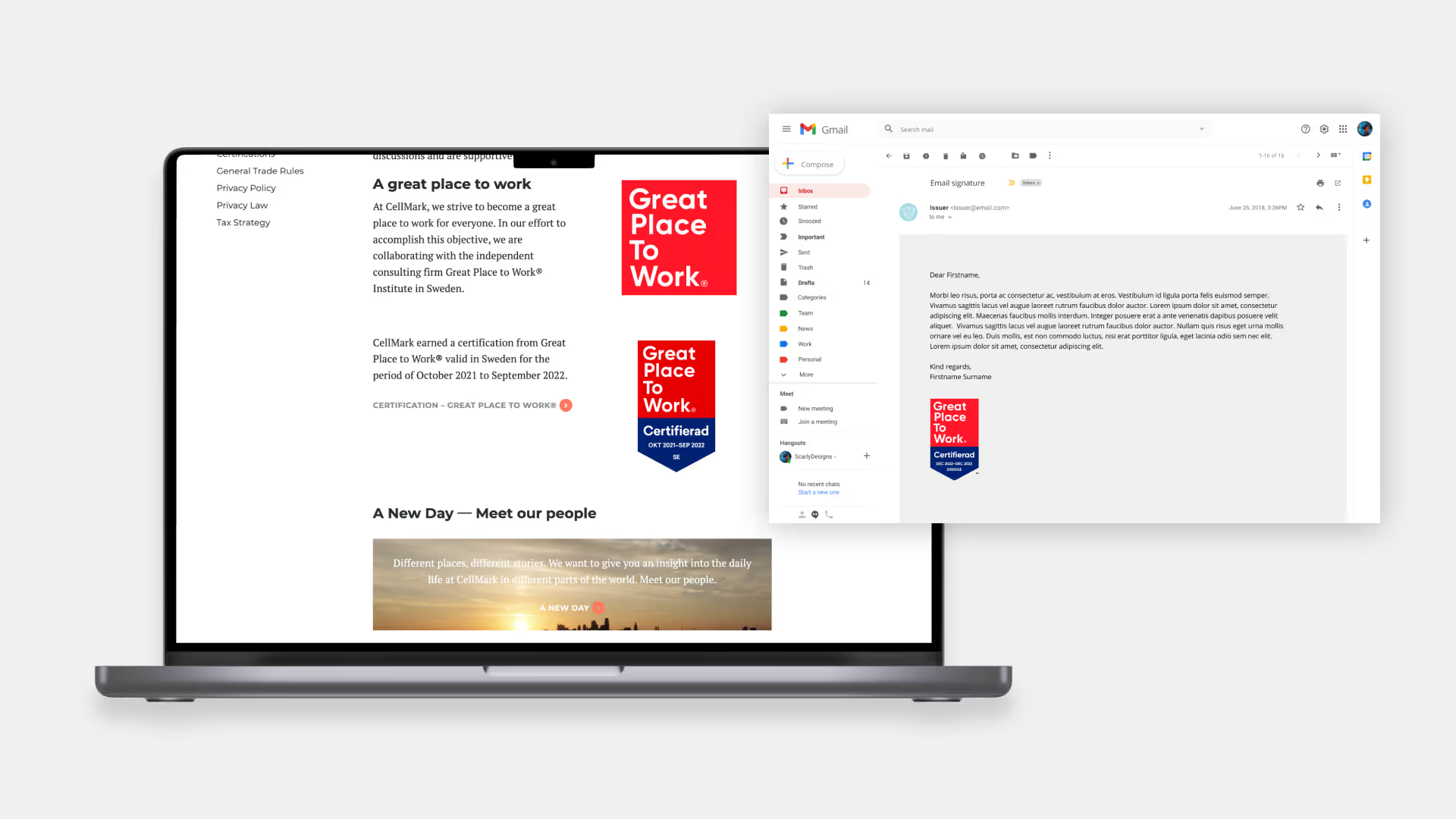
Badges also work in the other direction, from a certifying body to a whole company. Great Place To Work certifies employers on the strength of an employee survey and issues its certifications through TRUE Original. Close to a thousand certifications have been issued and viewed well over a hundred thousand times. Emma N Stara, CMO at Great Place To Work, puts the requirement plainly in TRUE's Great Place To Work case study:
"We work with trust every day, both in what we measure and in how we deliver results. That includes the certificates. They have to be secure, easy to verify, and reflect the quality of our brand."
Employers recognise a digital badge when they can check the record behind it, and more of them now hire on demonstrated skills. Seventy percent of employers in the National Association of Colleges and Employers' Job Outlook 2026 survey, published in January 2026, said they use skills-based hiring, up from 65 percent a year earlier. A TRUE Original badge links to a blockchain-secured TRUE document that a recruiter can check in TRUE Verify, free and without an account.
Where verified credentials sit in a hiring process is covered in digital credentials and skills-based hiring.
A digital badge is worth what a stranger can check about it. A badge backed by a verifiable record from a known issuer tells an employer or a client something a line on a CV cannot, while a badge that exists only as an image proves nothing, because an image can be copied.
For the earner, a checkable badge does several jobs at once:
For the issuer, every shared badge carries the issuer's name to the earner's network, and it can motivate colleagues to take the same course. A TRUE Original badge opens on the issuer's own domain, so every click lands on the issuer's website and not on a platform's. TRUE Original documents have generated over 100 million marketing impressions for their issuers. More on that in why certificates belong on your own domain.
Official badges also make life harder for impostors. A company that claims a membership or an accreditation it does not hold has nothing to link to.
To verify a digital badge, open the record behind the badge and check it against the issuer or a cryptographic proof, never against the image alone. Anyone can check a TRUE Original badge in TRUE Verify by pasting its link, its document ID or a PDF, free and without an account, and get a security level rating in seconds.
TRUE Verify checks documents against blockchain anchors, embedded digital signatures, issuer databases and more than 80 external credential platforms. TRUE Verify rates a document secured on a blockchain as carrying no risk of fabrication, and a document that exists only in an issuer's database as high risk. A printed TRUE document carries a QR code that leads to the same check.
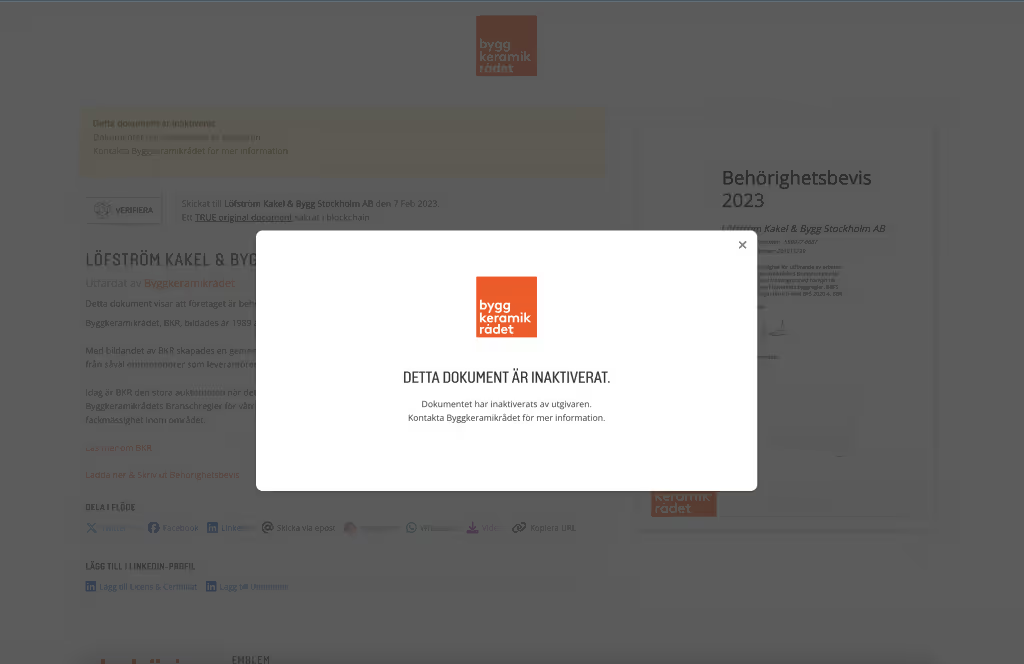
Verification also has to say when a badge stops being valid. TRUE Original lets national associations and certifying bodies withdraw or inactivate a certificate or a badge, so a membership that has lapsed shows as inactive to everyone who opens it. In the example below, INAKTIVERAT means INACTIVATED.
TRUE Original issues each digital badge as part of a blockchain-secured TRUE document, such as a diploma, a certificate, a licence or a membership, published on the issuer's own domain. The badge links to the full TRUE document. There is room there to explain the criteria, the issuer and the date, and anyone can check that nothing has changed.
An issuer can send TRUE documents from the TRUE dashboard, through a REST API with five endpoints, by structured email, or from Canvas LMS, Moodle, Learnster or Salesforce. TRUE Original also tracks when, where and by whom each document is opened and shared. How a recipient puts a TRUE document on a LinkedIn profile is shown in adding a digital certificate to LinkedIn.
TRUE Original was founded in Stockholm in 2020. It has issued over 900,000 documents for 200+ issuers in 15+ countries.
Each of those documents can still be checked by a stranger, without a phone call to the issuer.
A digital badge is a verifiable online record of a skill, achievement or membership, made of an image and the data behind it: who earned it, who issued it and the criteria that had to be met. The open standard for digital badges is Open Badges, maintained by 1EdTech.
The issuer defines an achievement and its criteria, awards the badge to a named earner, and the earner shares a link or file that anyone can open to see who issued it and why. A TRUE Original badge links to a TRUE document whose fingerprint is anchored on a public blockchain, so it can be checked years later.
A digital badge is worth what a stranger can check about it. A badge backed by a verifiable record from a known issuer tells an employer something a line on a CV cannot, while a badge that exists only as an image proves nothing.
Digital badges for employees are badges an employer or industry body awards to staff for completed training, certifications, licences or internal programmes. According to 1EdTech's Badge Count 2025, employers issue badges through 62% of the 24 badge platforms surveyed.
Open the record behind the badge and check it against the issuer or a cryptographic proof, never against the image alone. Anyone can check a TRUE Original badge in TRUE Verify by pasting its link, document ID or PDF, free and without an account.
Yes. TRUE Original issues each badge as part of a TRUE document whose fingerprint is anchored on a public blockchain, among them Ethereum and Polygon, and publishes it on the issuer's own domain.
A digital badge recognises one skill or achievement, while a certificate covers a whole course or training. TRUE Original issues both from one platform, and a TRUE Original badge links to the TRUE document behind it.
Employers recognise a digital badge when they can check the record behind it. Seventy percent of employers in NACE's Job Outlook 2026 survey said they use skills-based hiring, up from 65 percent a year earlier, and a recruiter can check a TRUE Original badge in TRUE Verify, free and without an account.
Every organisation we work with started with the same question. Give us thirty minutes and we will show you what your own documents would be worth.
Book a callNot sure where to start? Let us help!

Trusted by leading organisations worldwide