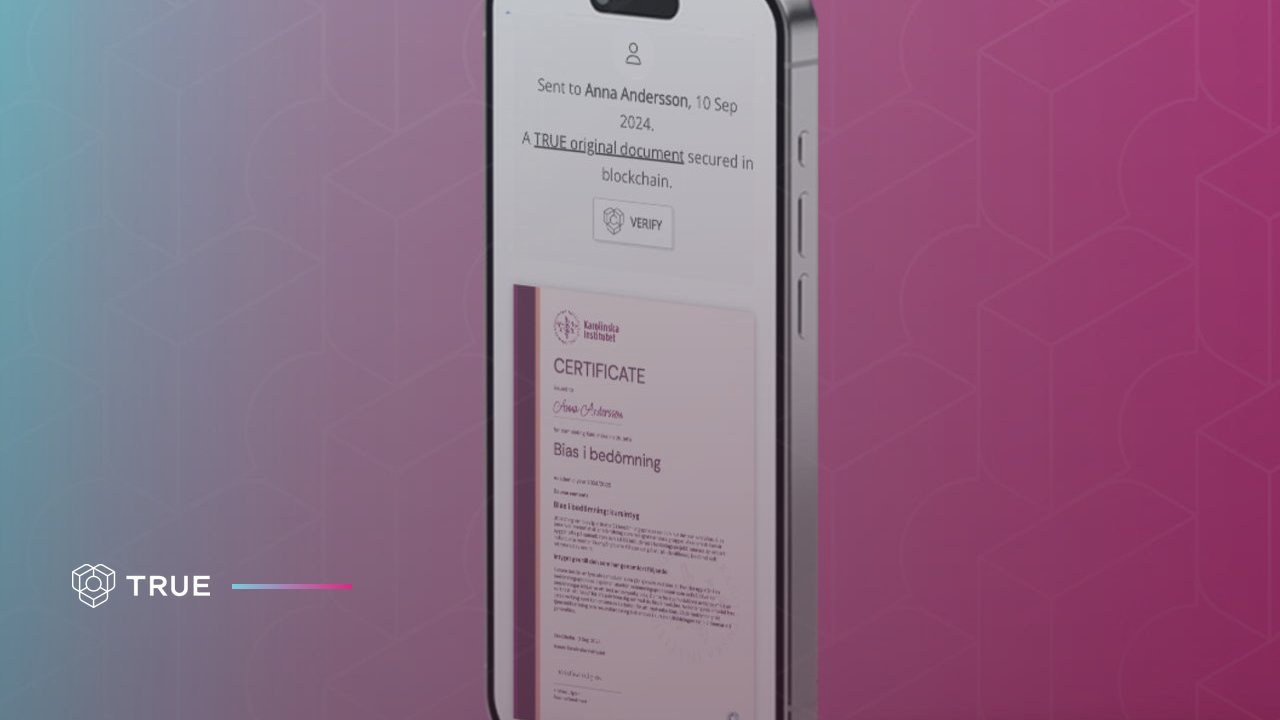
When a healthcare professional presents a training certificate, the stakes are not administrative — they are clinical. A credential issued by a prestigious institution like Karolinska Institutet carries weight precisely because it signals competency in contexts where errors cost lives.
That is why Karolinska Institutet chose to issue its medical training certificates through TRUE — and why the decision to go with blockchain-secured credentials was not just a technology choice, but a patient safety decision.
Medical training certificates travel far. A course completed in Stockholm becomes part of a practitioner's professional identity in Oslo, London, or Singapore. The certificate is shown to employers, regulatory bodies, and sometimes patients themselves.
But paper can be lost. PDFs can be altered in minutes. In an industry where a fake credential could mean an unqualified person performing a procedure, the gap between "looks legitimate" and "is legitimate" has serious consequences.
Karolinska Institutet evaluated the available options. The requirement was clear: a certificate that could be verified by anyone, anywhere, without calling a registrar — and that could not be forged.
Karolinska Institutet selected TRUE after evaluating competing platforms. The deciding factors were security architecture, ease of integration, and long-term reliability.
TRUE connects directly to Canvas, KI's existing learning management system. When a participant completes a course, a blockchain-secured certificate is issued automatically — no manual administration, no delays, no separate workflow.
Each certificate issued is:
The Canvas integration means the process is invisible to staff. Training happens as before. The difference is what the certificate becomes afterward.
Since moving to blockchain-secured certificates, Karolinska Institutet's training credentials carry a level of verifiability that traditional formats cannot match.
Recipients share them directly with employers and professional networks. Verification requests that previously required manual follow-up now resolve in seconds via link. The certificates maintain their integrity regardless of where they end up or how many years pass.
For an institution where reputation is built over decades and defended one credential at a time, that permanence matters.
Karolinska Institutet is home to the Nobel Committee for Physiology or Medicine. It is one of the most cited medical research institutions in the world. When an organization at that level evaluates credential platforms and selects TRUE, it is a statement about what the standard should be.
Medical training is not a commodity. The certificates that represent it should not be either.
Ready to see how TRUE works for healthcare and professional training?
Talk to a specialist at TRUE
Every organisation we work with started with the same question. Give us thirty minutes and we will show you what your own documents would be worth.
Book a callNot sure where to start? Let us help!

Trusted by leading organisations worldwide