If you issue certificates, diplomas, badges, or licenses, the platform you choose shapes how recipients share them, how employers verify them, and how much brand value you keep. In 2026 the market has matured around five clear contenders.
This guide compares them honestly. Each has real strengths and real trade-offs. We've put TRUE Original first because that's our platform — but we've held it to the same standard as the rest, including pointing out where it falls short.
What to look for in a credential platform:
| Platform | Blockchain | Custom Domain | API | LMS Integration | Starting Price | Price published | Best For |
|---|---|---|---|---|---|---|---|
| TRUE Original | Yes (Ethereum, AVAX, Fantom, Polygon) | Yes — issuer's own domain | Yes (5 endpoints) | Canvas, Moodle, Learnster | From 100 EUR/month on a yearly contract | Yes, trueoriginal.com/faq | Branded, marketing-driven, blockchain-secured documents |
| Credly (Pearson) | No | Limited (Credly subdomain) | Yes | Yes (broad LMS support) | Not published | No. credly.com/pricing redirects to a contact form | Large IT certification programs, Open Badges-first orgs |
| Accredible | Optional blockchain anchoring | Yes | Yes | Canvas, Moodle, Zapier | From $45/month on a 12 month term (Launch, 50 recipients) | Yes, accredible.com/pricing | Universities, professional associations, high-volume issuers |
| Certifier | No | Yes | Yes | Limited | Free plan $0 (250 credentials/year); Professional $67/month billed annually (1,000/year) | Yes, certifier.io/pricing | Smaller teams, course creators on a budget |
| Sertifier | No | Yes | Yes | Yes (LMS-focused) | Free plan $0/year (250 recipients); Pro $250/year (250 recipients) | Yes, sertifier.com/pricing | Course providers prioritizing badge design and LMS workflows |
Every figure in this table was read from the vendor's own pricing page on 18 August 2026, and each link goes to the page it was read from. Where a vendor publishes no price, the table says so instead of guessing. Vendors change prices, so confirm before you buy.
Book a FREE Demo to see how TRUE compares against your shortlist.
What it does. TRUE Original is a Swedish platform for creating, issuing, and verifying secure digital documents — certificates, diplomas, awards, badges, licenses, memberships, transcripts, and more. Documents are blockchain-secured, branded, animated, and live on the issuer's own domain.
Who it's for. Training providers, certifying bodies, professional associations, education institutions, and corporate L&D teams that treat each issued document as both proof and a marketing asset.
Key features
Pricing. Published. TRUE lists a starting price of 100 EUR per month on a yearly contract in its own FAQ, read there on 18 August 2026, with special pricing for non-profits and some educational institutions. Above that entry level, quotes are tailored to volume and integration needs.
Pros
Cons
Verified scale. 900,000+ documents issued, 200+ issuers, 15+ countries.
What it does. Credly is the largest digital badging platform globally, owned by Pearson since 2022. It centers on the Open Badges standard and is the default for many large IT certification bodies.
Who it's for. Large enterprise certification programs (especially in IT and tech), organizations whose recipients expect a Credly profile, and buyers prioritizing Open Badges compatibility.
Key features
Pricing. Not published. On 18 August 2026, credly.com/pricing redirected to a contact form on info.credly.com, so every quote starts with a sales conversation. Credly is positioned at the enterprise end of the market.
Pros
Cons
If you're actively comparing alternatives, see our Credly alternative page.
What it does. Accredible is a digital credentialing platform popular with universities, professional associations, and enterprise certification programs. It emphasizes design flexibility and high-volume issuing.
Who it's for. Higher education institutions, large professional associations, and enterprise certification programs that issue at high volume and want flexibility in design and pathways.
Key features
Pricing. Published. The Launch plan starts at $45 per month on a 12 month term and covers 50 recipients, read on accredible.com/pricing on 18 August 2026. The Connect and Growth plans are quoted individually.
Pros
Cons
For a closer comparison, see our Accredible alternative page.
What it does. Certifier is a newer, marketing-led credentialing platform aimed at course creators and smaller teams. Self-serve onboarding, transparent pricing, and a free tier make it accessible.
Who it's for. Course creators, online educators, and smaller training providers that want to start issuing branded certificates quickly without a sales process.
Key features
Pricing. Published. The free Starter plan is $0 for 250 credentials a year, and Professional is $67 per month billed annually at 1,000 credentials a year, read on certifier.io/pricing on 18 August 2026. Both prices rise as you raise the annual issuing limit.
Pros
Cons
For a side-by-side comparison, see our Certifier alternative page.
What it does. Sertifier is a credentialing platform with a strong focus on badge design and LMS integration. Marketing-friendly recipient flows and clean UX make it a common pick for course providers.
Who it's for. Course providers, training companies, and event organizers that want shareable, well-designed credentials with workable LMS integration at an accessible price.
Key features
Pricing. Published. The free plan is $0 a year for 250 recipients, and Pro is $250 a year at the same 250 recipients, read on sertifier.com/pricing on 18 August 2026. The Pro price rises as you raise the recipient count, and Enterprise is quoted individually.
Pros
Cons
There's no single best platform — only the best one for your recipients, volume, compliance needs, and brand. Use this framework to narrow down.
Priorities: low cost, fast setup, transparent pricing, good share flow.
Strong fits: Certifier and Sertifier — both have free tiers and self-serve onboarding. Test with a real cohort before committing.
Priorities: branding control, recipient experience, LMS integration, marketing value.
Strong fits: TRUE Original and Accredible. You're past the point where free tiers scale comfortably. You want documents that drive traffic back to you, integrate cleanly with your LMS, and look like your product — not a vendor template.
Priorities: scale, security and compliance, network effects, governance.
Strong fits: Credly, Accredible, TRUE Original. At this volume, factor in SSO, advanced compliance (eIDAS, ISO 27001, SOC 2), and how recipients in your industry already behave. If they already have Credly profiles, switching has friction. If brand control and on-domain credentials matter more than network effects, weight accordingly.
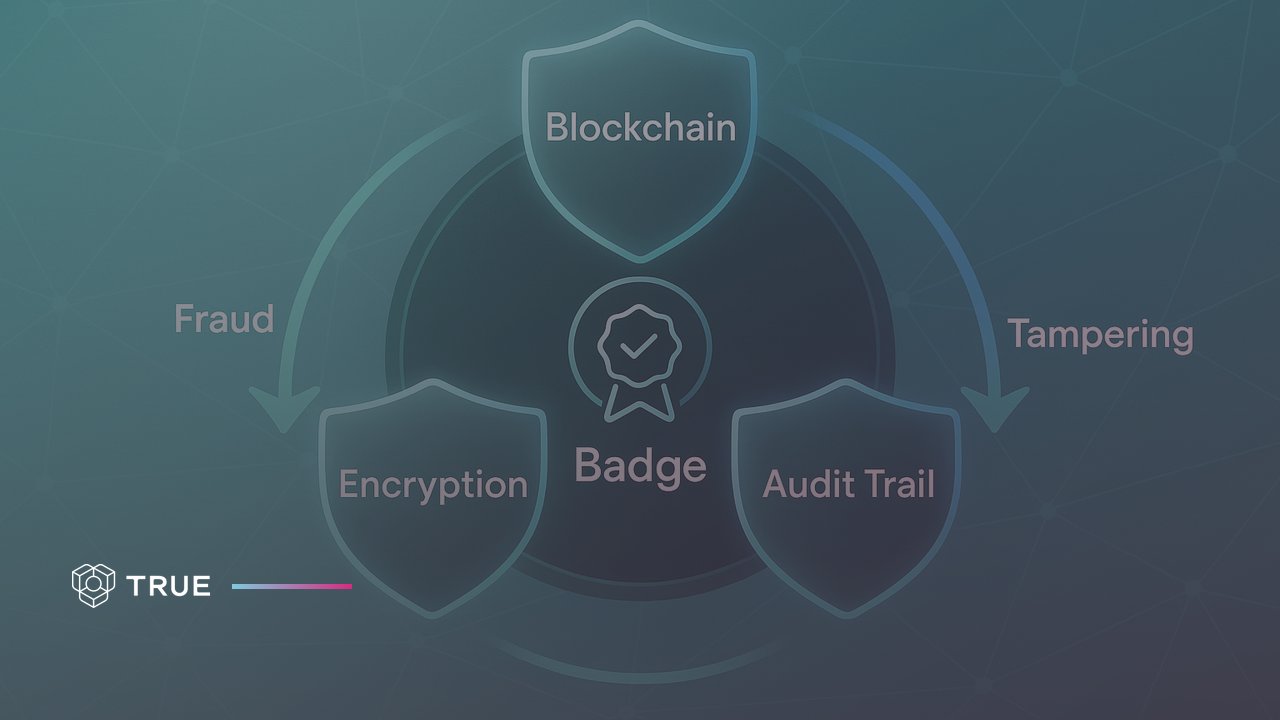
Choose a platform with on-chain immutability — among the five here, that's TRUE Original (with optional anchoring on Accredible). PDFs can be edited; database records can be silently changed; blockchain records cannot.
Pick a platform that treats each shared credential as a brand impression — measured, branded, on your domain. TRUE Original is built around this; Accredible is workable if you invest in customization.
A certificate proves the course happened. It does not bring you the next student.
Only two of the five platforms here list their issuers' courses publicly. But only one does it without bias. Accredible runs CourseFinder, where issuers pay per click for a featured slot. TRUE runs TRUE Upskill, free for both educators and students.
Consider visibility, not only issuing. On one of them, better placement has a price. On the other it costs nothing.
There's no single "best" — the right platform depends on what you need. For sheer reach into IT certification ecosystems, Credly leads. For design-flexible enterprise issuing at scale, Accredible is strong. For self-serve simplicity, Certifier is fast to start. TRUE Original is built for organizations that want credentials hosted on their own domain, secured by blockchain, and designed to drive marketing value — a fit for European institutions, training providers, and certifying bodies in particular.
Credly is badge-first, centered on the Open Badges network and IT certifications. Accredible is design-flexible and tuned for high-volume university and association issuing. TRUE Original differs structurally: credentials live on the issuer's own custom domain (not on a shared platform domain), every document is anchored on blockchain for tamper-evident verification, and an eIDAS-qualified electronic seal layer gives the document cross-border legal status across the EU. The three solve overlapping problems with different architectural priorities.
A digital credential platform is software that lets organizations create, issue, and verify digital documents — certificates, diplomas, awards, badges, licenses, memberships, transcripts, and more — instead of (or alongside) paper or PDF. It typically includes a designer, an issuing engine (manual, bulk, API, or LMS-triggered), recipient share tools, and a public verification page so anyone can confirm a document is real. The best platforms also offer tamper-proof storage (often blockchain), branded recipient experiences on the issuer's own domain, and analytics on how documents are viewed and shared.
TRUE Original and BCdiploma are the two platforms in the current market where blockchain anchoring is core to the architecture — every credential is hashed and recorded on a public chain (TRUE uses Ethereum, AVAX, Fantom, and Polygon). Accredible offers optional blockchain anchoring as a tier. Sertifier anchors credentials on Velocity Network, a permissioned consortium chain rather than a blockchain. Certifier markets blockchain-backed credentials but does not publicly document the network used. Credly does not anchor credentials on blockchain as a standard feature.
Credly is built around Open Badges and supports both 2.0 and 3.0. Accredible supports Open Badges 2.0 with 3.0 support rolling out. Sertifier supports Open Badges 2.0. TRUE Original aligns with the verifiable credentials principles behind Open Badges 3.0 (recipient-owned, blockchain-verifiable) — though the TRUE document format is broader than badges, covering certificates, diplomas, licenses, transcripts, and other credential types beyond the badge model.
It depends on what you need. For branding control, on-domain documents, and blockchain verification, TRUE Original is the strongest fit. For high-volume universities and associations that want design flexibility, Accredible is a serious option. For smaller teams on a budget, Certifier and Sertifier offer free tiers and transparent pricing. Shortlist two or three based on your real priorities, run pilots, then choose.
The answer depends on what drew you to Accredible in the first place. If it was the design flexibility, Certifier is lighter-weight and self-serve. If it was high-volume issuing for universities and associations, TRUE Original offers similar capacity with blockchain verification and on-domain hosting included. For organizations specifically needing eIDAS-qualified credentials for European recognition, TRUE Original is the only commercial provider in Sweden offering qualified-sealed, EDCI/Europass-compatible diplomas in bulk to higher-education institutions.
Universities increasingly need EU-recognized, EDCI/Europass-compatible credentials that can travel into the EU Digital Identity Wallet. TRUE Original is built for this case — it holds an eIDAS-qualified electronic seal certificate (issued by SK ID Solutions AS, a QTSP on the EU Trusted List) and can issue diplomas under the Europass Mandated Issue model, meaning the university stays the named issuer without needing its own eSeal. For US-centric universities and IT certification bodies, Credly's reach into employer networks is unmatched. Accredible suits both with design-flexible templates and strong API tooling.
Not always. Blockchain offers one specific, important advantage: immutability. Once a credential is written to a public chain, neither you, the vendor, nor a bad actor can silently change it — and verification doesn't depend on any single company staying in business. For high-stakes documents (professional licenses, regulated certifications, degrees, awards with reputational weight), that's a meaningful trust upgrade. For lower-stakes documents (event attendance, internal training), database-backed verification is often fine. What matters is whether the platform actually writes to a public chain, how verification works for recipients, and whether the recipient flow stays simple.
Pricing varies widely. Free tiers exist on Certifier and Sertifier, each capped at 250 credentials or recipients a year. Entry paid plans on those platforms are published: $67 per month billed annually on Certifier, $250 a year on Sertifier. Among the larger platforms, Accredible publishes $45 per month and TRUE Original publishes 100 EUR per month, while Credly publishes no price at all and sends buyers to a contact form. All four published figures were read from each vendor's own pricing page on 18 August 2026. Above the entry plans, every one of these platforms quotes individually. When comparing, calculate cost per credential at your real expected annual volume, and factor in the marketing value of recipient sharing: a credential that drives one new student or client back can pay for the platform many times over.
Each platform has its own verification flow. Credly credentials verify via the recipient's credly.com profile. Accredible credentials verify via the issuer's Accredible page or Open Badges verification. TRUE Original credentials verify through a free public tool at trueoriginal.com/verify — anyone can paste the credential file or URL and immediately confirm whether the document is unchanged since it was secured, who issued it, and when. No account required.
Yes — and it's more straightforward than most people expect. The typical migration path:
Most modern Credly alternatives, including TRUE Original, support this migration. Ask the vendor specifically about bulk import and re-issue tooling.
There's no universally best digital credential platform — only the best one for your recipients, your volume, your compliance needs, and your brand.
If you want to see what blockchain-secured, branded-domain, marketing-driven documents look like in practice, we'd be happy to show you. TRUE Original has issued 900,000+ documents for 200+ organizations across 15+ countries, and the platform is built around the idea that every document you issue should reinforce your brand.
Book a FREE Demo — 30 minutes, no slide deck, just your real use case.
Or contact us with questions and we'll point you in the right direction — even if it isn't us.
Every organisation we work with started with the same question. Give us thirty minutes and we will show you what your own documents would be worth.
Book a callNot sure where to start? Let us help!

Trusted by leading organisations worldwide